
We believe that sustainability is still possible!
The ongoing pushback against sustainability-oriented legislation makes the SMART Network as urgent and important as ever. Denial of unsustainability risks and the comforting illusion of business-as-usual is driving humanity toward a very certain path towards a very uncertain future. Yet, we, the Steering Committee of the SMART Network, continue to believe in SMART’s mission statement that sustainability is possible.
The EU-funded project SMART (Sustainable Market Actors for Responsible Trade, 2016-2020) sought to identify the factors that would facilitate the contribution of businesses and other market actors to sustainability. Drawing on SMART’s framework, the starting point for this symposium is that sustainability is about securing social foundations for humanity everywhere, now and in the future, while mitigating pressures on planetary boundaries. In short, it is about ensuring a safe and just world for humans and other living creatures.
At its conclusion in February 2020, the SMART project published reform proposals which covered three main strands: Business, Finance and Products. These proposals encompassed trade and investment law, business law, company law and accounting law, financial market law and banking, public procurement, and circular economy law. In the intervening years, these proposals have informed legal reforms and provided a foundation for a new range of research projects and publications.
It is now time to take stock, look back at the work, reform proposals and legacy of the SMART project and look forward to what needs to be done and how it can be achieved.
SMART Network Symposium Programme
Thursday 18 and Friday 19 September (all times CEST)
Day 1: Thursday 18 September
1 pm: Welcome. Keynote by Christopher M. Bruner
2-4 pm: Panel 1. Re-imagine the economy within planetary boundaries. Chair: Lorenza Mola
- Rosalind Malcolm et al., Living Well on a Finite Planet: A Multidimensional Systems Approach to Sustainability
- Mattia Colli Vignarelli, Towards a Duty to Stay Within the Planetary Boundaries: Integrating the Global and the Local Dimensions of Sustainability
- Florian Couveinhes Matsumoto & Sabrina Robert, Reinterpreting the EU-Mercosur Rebalancing Mechanism and its Implementation: from Economic Compensation to Economic Support for the Socio-ecological Transition
- Mirjana Drenovak-Ivanovic, From Compliance to Transformation: How EU Sustainability Legislation Shapes Legal Reforms in Candidate Countries for EU Membership
4-4.30 pm: Break
4.30-6.30 pm: Panel 2. Re-frame accounting and finance for sustainability. Chair: Beate Sjåfjell
- Javier Solana, The responsibility of the Eurosystem as owner and operator of payment systems
- Fabrizio Sudiero, Sustainability-Linked Bonds: Mitigating Greenwashing through Private Enforcement
- Jukka Mähönen and Vera Palea, Analyzing Double Materiality Through the Lens of the European Political Constitution: Implications for Interoperability and Standards-Setting
- David Monciardini, EU-driven Corporate Sustainability and Accountability: Paradigm Shift or Regulatory Capture?
Dinner for organisers and speakers
Day 2: Friday 19 September
9-11 am: Panel 3. Re-form corporate governance and global value chains. Chair: Harm Schepel
- Beate Sjåfjell, The Board’s Duties in Governing Global Value Chains
- Anne-Marie Weber, Advancing Sustainable Corporate Governance in the Capital Markets Union
- John Quinn, Sustainability Through Process: Reflexive Corporate Regulation
- Elena Corcione, Follow the Money: A New Accountability Paradigm for Human Rights Violations in Global Value Chains?
11-11.30 am: Break
11.30 am-1.30 pm: Panel 4. Re-design products and practices for sustainability, Chair: David Monciardini
- Carl Dalhammer, The Major Flaws in the EU Legal Framework for Sustainable Products
- Feja Lesniewska, Circular Track and Trace: The Rise and Rise of Digital Product Passports as a Gateway to Sustainable Circular Economy - A Legal Analysis
- Katrien Steenmans and Federica Muscaritoli, A Review and Investigation of Circular Procurement Practices: Promoting or Challenging the Status Quo?
- Aude-Solveig Epstein, Beyond Eco-Modernization: Reorienting Environmental Law to Transform Technological Infrastructure
1.30-2 pm: Concluding reflections by Beate Sjåfjell
2-3 pm: Lunch for all participants
Secure your seat at the symposium, by registering today! Digital participation is also an option. Registration closes tonight, 16 September 2025, at 23:59 CEST.
******
SMART Network Meeting
Friday 19 September, 3:00–4:30 pm
The symposium aims to revitalise the SMART Network by reestablishing connections between existing members and welcoming new friends and colleagues interested in sustainability-focused research. Interested in joining? Check out the SMART Network!
Register for the SMART Network Meeting! The Network Meeting will also be hybrid. Registration closes tonight, 16 September 2025, at 23:59 CEST
Informal dinner for participants at the SMART Network Meeting
About the University of Turin
The University of Turin was founded in 1404. Ludovico of Savoy-Acaia promoted the establishment of a higher education centre, urged by some ‘magistri’ who had fled the university centres of Pavia and Piacenza. The chosen location was Turin, as it was an episcopal city. In the beginning there were only three Faculties: Theology, Law and Medicine.
Currently, with approximately 120 locations spread across seven main campuses, high-level scientific research, and cutting-edge teaching methods, the University of Turin stands as one of the most prestigious academic institutions in the Italian university landscape and as one of Italy’s five largest universities.
The University of Turin (UNITO) is an institution dedicated to research, capable of providing a fundamental contribution to technological progress, cultural growth, and peaceful coexistence, thereby laying the groundwork for innovative and dynamic teaching. It is deeply rooted in the territory, yet endowed with international vocation, actively committed to fostering innovation and social, cultural, and economic growth for both the country and the international community.
UNITO now has 27 Faculties, including the Law Department and the Department of Economics and Statistics ‘Cognetti de Martiis’, which will host the conference. Both Departments are located in the modern Luigi Einaudi Campus, built in 2012. The campus is conveniently located close to the city centre and it was designed by the British architect Norman Foster. It was nominated by CNN as one of the ten most beautiful university buildings in the world.
About Turin
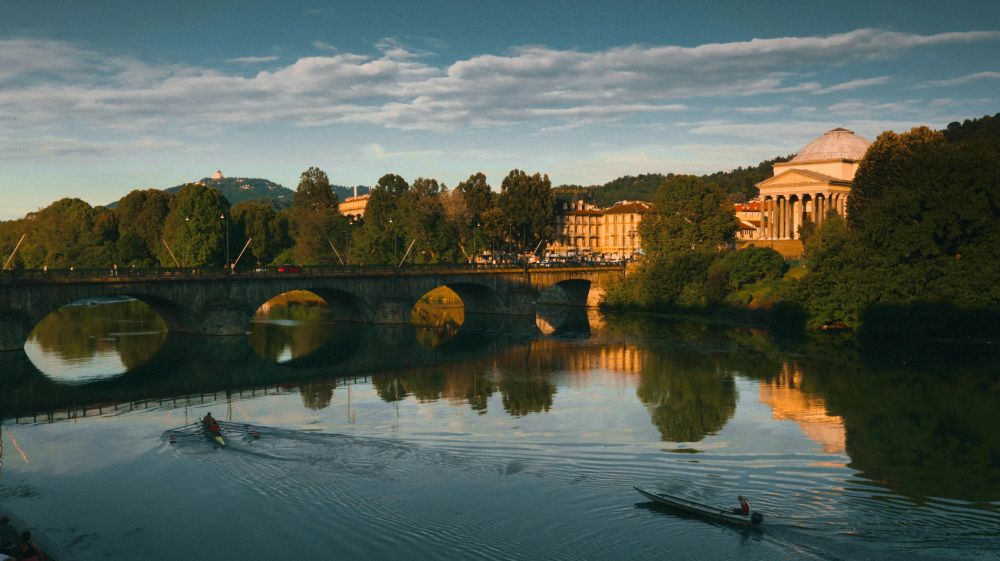
Situated in the northwest of the country, on the banks of the Po River and surrounded by the Alps, Turin is the administrative centre of the Piedmont Region and the third biggest city in Italy. The urban area is bordered by what has always been historically known as the ‘Corona delle Delizie’, meaning the crown of delights, formed by the Royal Residences dotted around the outside of the city.
Turin is a major cultural and economic European centre. More than two thousand years of history have contributed to build up an incredible heritage: from the Roman Empire, through the Middle Ages, the Savoy court, becoming the first capital of Italy in 1861 over the Risorgimento, to being the capital of Italian industrial production over the 20th century with carmakers such as FIAT.
Turin and the whole Piedmont region also offer magnificent cuisine. Whatever your taste, you will be delighted by a wine (Barolo and Barbera for example) and food tour that takes in historical cafés, wine shops and bars, stores and restaurants along the way.
Getting to Turin and getting around in Turin
We encourage participants to travel by train to Turin where possible, as Turin has excellent train connections for example through France and Switzerland. There are airports nearby in Turin and Milan, for those who need to travel by plane. More information is available here. It is very easy to get around in Turin, by foot and by public transport.
Organisers
The SMART Network Steering Committee:
Prof. Beate Sjåfjell (University of Oslo)
Prof. Roberto Caranta (University of Turin)
Prof. Blanaid Clarke (Trinity College Dublin)
Dr Shouvik Guha (West Bengal National University of Juridical Sciences)
Dr Aude-Solveig Epstein (Paris Nanterre University/NYU Abu Dhabi)
Dr John Quinn (Dublin City University)
Local organising committee at the University of Turin
Roberto Caranta
David Monciardini
Mia Callegari
Eva Desana
Lorenza Mola
Vera Palea