
We have heard the saying about placing a cat among the pigeons before, and we know that the cat does not live solely in rural districts. The question is whether the cat is also looking after the pigeons in the Storting and the state administration.
Local self-government is an expression referencing the rights of municipalities and county municipalities to govern themselves. It is the common perception that local self-government is a strong principle in Norway.
However, when we look at the rights of municipalities to govern in light of the rights of the Storting and the state administration to govern them, it becomes clear that local self-government does not have a strong legal safeguard.
Not in sync
"The Norwegian regulations are not in accordance with the central provisions in the European Charter of Local Self-government, and they also differ from the Danish, Swedish and French rules on this. The charter is binding for the Norwegian authorities, and it represents an obligation that Norway has had for over 20 years," states Sigrid Stokstad.
She has written a doctoral dissertation at the Faculty of Law in Oslo on local self-government and the legal capacities to act that the Storting, state administration and municipalities possess in relation to each other.
The goal has been to clarify what local self-government actually is in Norwegian law, and to point out legal means that can strengthen or weaken local self-government.
Unclear Norwegian legal framework
According to Stokstad, the European Charter requires that the principle of local self-government be established in law, and if possible be included in the Constitution. The constitutions of Sweden, Denmark and France have done this, whereas the Norwegian Constitution lacks such rules.
"Nor is the principle of local self-government clearly described in the Norwegian legal framework," she says.
"The issue of local self-government having to be in the Constitution has come up many times, but the Storting has rejected the proposal repeatedly"
Legal authority needed to play with the pigeons
"Where then does the cat come in?"
"In order for the state administration to be able to intervene with respect to the municipalities, the legal authority to do so must exist in the code of laws. Norwegian law grants the state administration comprehensive legal authorisation to examine and review decisions made by municipalities. At the same time, municipalities have an extremely limited ability to bring the state administration's decisions before the courts. Hence the state administration itself has the last word when legal provisions concerning the latitude of the municipalities to act are to be interpreted."
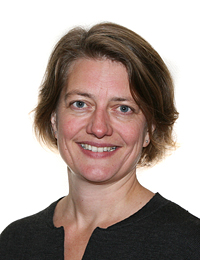 Sigrid Stokstad has written her doctoral dissertation at the Faculty of Law in Oslo. Photo: Sjøwall
"The municipalities in Norway are more subordinate to the sate administration than they are in Sweden, Denmark and France. Norway clearly distinguishes itself by agencies of the state administration widely reviewing decisions of the municipalities."
The courts ought to be controlling the state
According to the Charter, the states must have an internal system for checking that the national authorities are respecting local self-government. Local authorities must be able to go to courts or similar independent bodies in order to examine whether the state's administration is within the framework set by the national code of laws.
Such control by the courts would mean that national authorities could not determine all by themselves how far they can go in governing local authorities.
"On this point, Norway's fulfilment of its international obligations is deficient," says the researcher.
"Decisions by the municipalities are also examined and reviewed under Swedish, Danish and French law. Such reviews take place however in bodies that are independent of the state administration. Their municipalities are to a much larger degree than ours able to have decisions by the state administration examined by the courts."
We can learn from our neighbours
In her dissertation, she places a significant emphasis on comparing the systems in the Nordic countries.
"It is natural to compare us with Sweden and Denmark because we are so alike. They are all models of Nordic welfare states that are able to elucidate different manners in which local self-government can be arranged in different welfare state models. France is known to be an extremely centralised state, however they have decentralised more of the power recently and also have constitutional provisions concerning local self-government."
Local commitment
Precisely what consequences can such a lack of legal safeguards have for local self-government in terms of local political developments?
"I believe there is an interrelationship between having the authority to make decisions and there actually being a local commitment. If the municipalities are drained of their power, it will probably be less interesting to be involved with them politically. Local self-government comprises of course a basis for local democracy, and it is here where most people have the opportunity to experience democracy at close range."
Ambiguous messages
"Why have we not made any further progress in Norway in fulfilling the provisions in the Charter?"
"In my experience, there is an ambiguity in the discussion concerning local self-government. On the one hand, self-government is highlighted as being important and praised in political contexts. On the other hand, the politicians are showing that local self-government is of lesser significance by lacking the will to give it legal safeguards. In Norway, we accept that municipalities have the latitude to act as long as they are not in conflict with national politics."
"If disputes arise, the interests of the municipalities must often yield to the national interests. National authorities also take precedence in the other countries I have looked at, but the view that the state must decide is significantly stronger here."
 "The politicians are showing that local self-government is of lesser significance by lacking the will to give it legal safeguards." Photo: Colourbox.com