New technologies continue to affect the premises on which legislation is based and may also challenge the attainment of the legislative purposes. Artificial intelligence is rapidly transforming the way we acquire, create and share information and it’s becoming crucial to understand the interaction between the technology and the legal frameworks affected.
Meanwhile, the EU legal framework on data and AI is becoming increasingly complex, partly because of the interaction with other legal areas, such as copyright. This complexity is heightened by the interplay between EU and EEA law.
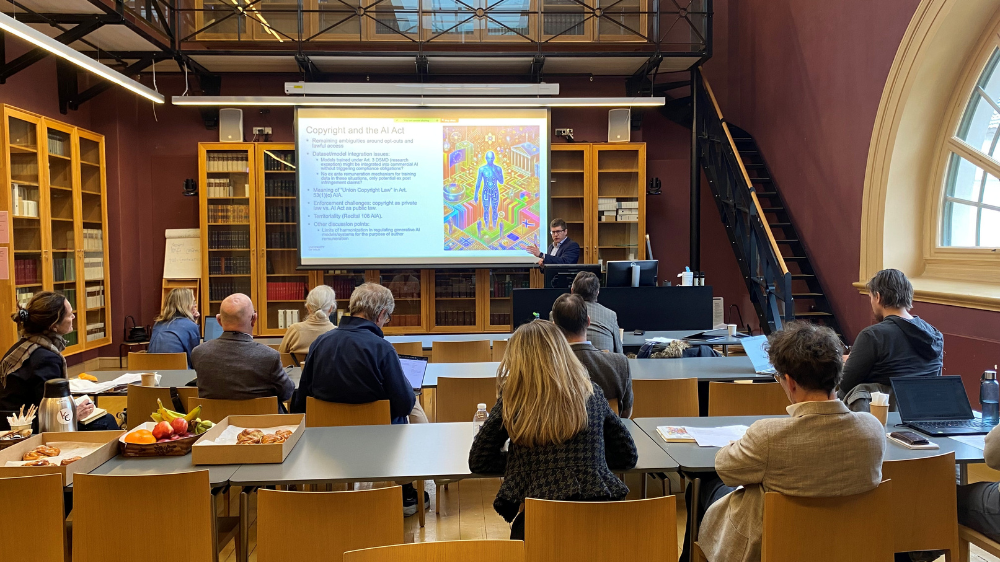
On March 12, the EURNOR project hosted a workshop at the University of Oslo, featuring PhD candidate Guro Bøe Linnet’s research on the legal challenges it creates. Applying a "bottom-up" approach, Linnet’s research addresses specific questions on interpretation and implementation of EU/EEA secondary law on technology and copyright to draw broader conclusions about methodological and systemic aspects of EU/EEA law.
In the workshop hosted by EURNOR, Linnet held introductions to four key topics in her research:
- author remuneration in generative AI training
- the interplay between copyright and the AI Act
- regulation of interfaces between EU/EEA digital legal acts through "without prejudice" clauses
- the implementation backlog in the EEA
Following Linnet's introductions, Professor Dr. Thomas Margoni (KU Leuven) — a leading scholar in the field of intellectual property and AI law — offered his perspectives on several challenges in this area.
AI and Copyright and other legal interfaces
Professor Margoni offered key reflections on the challenges posed by the interaction between territorial copyright law and the extraterritorial AI Act. He also explored questions related to the potential enforcement of copyright obligations under the AI Act, and more broadly, how the regulation of AI within the EU/EEA may impact innovation and legal certainty for relevant stakeholders.
Another critical topic discussed was how generative AI is changing the ways in which copyright is exploited. How can the use of protected works in developing AI be understood within the existing copyright framework? And how can copyright holders be adequately compensated for the use of their works?
Professor Margoni also offered insightful commentary on the use of "without prejudice" clauses in EU legislation. The following discussions explored possible institutional factors behind their frequent use, including structural features and dynamics within the EU law-making process.
The workshop featured lively and constructive discussions that deepened the understanding of the regulatory challenges.