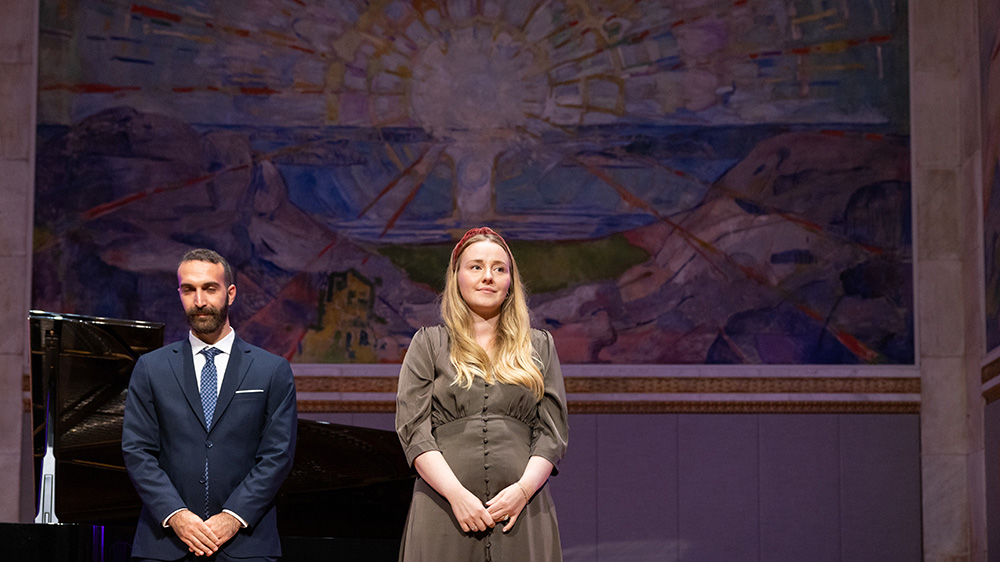
During UiO's annual celebration ceremony on September 2, 2024, UiO's Sustainability Award for Best Master's Thesis was awarded to three students. One of the prize winners was Frida Kvål Salberg, who received the award for her master's thesis "Intellectual Property Rights and the right to repair - A case study of independent repair of smartphones." The award honors students who excel in sustainability-related topics and demonstrate both originality and high quality in their work. One of the criteria is that the master's thesis contributes to increased insight into sustainable development.
Investigates Three Different Cases
Among the measures to ensure a sustainable future are reducing consumption and prioritizing the repair of possessions. In her master’s thesis, Salberg found that current legal regulations make this challenging, affecting the path towards achieving the UN's sustainability goals by 2030.
– Specifically, I'm examining three different situations where copyright, patent law, and trademark law can make it more difficult for independent repairers to fix smartphones, Salberg explains.
The idea for the thesis blossomed when she was appointed as a research assistant and became familiar with the research environment in the research group Sustainability Law at the Department of Private Law. She was affiliated with the Circular Energy project, which dealt with the transition to a sustainable circular economy, particularly in maintaining electronics.
– I found my topic and research question after reading the Supreme Court ruling HR-2020-1142-A, where an independent repairer lost a trademark case against Apple, and sustainability considerations were raised by the defendant, says Salberg.
In her master's thesis, Salberg argues that current intellectual property law constitutes a significant barrier to independent repair of smartphones, necessitating new legal solutions:
– This issue can be written about extensively and complexly, but overall, much can be resolved by reviewing current regulations, as intellectual property rights are not adequately addressed by the EU or the government when a Right-to-Repair is discussed.
Participation in Research Group Became a Learning Experience
Salberg emphasizes that being part of a research group during the master's program was both educational and useful:
– It is inspiring to work with talented and hardworking people. The green transition, which includes a shift to a sustainable circular economy, requires considerable effort and, for many, a change in mindset. It's great to work in a research group that takes this work seriously.
Someone particularly impressed by Salberg's work and effort is her supervisor, former postdoctoral fellow at the Department of Private Law, Eléonore Maitre-Ekern:
– I am grateful to Circular Energy (funded by UiO:Energy and Environment) for the opportunity to hire master students to write on topics that are very important but otherwise largely fall off the radar of legal research at UiO. The way and speed at which Frida grasped the issues has been truly impressive. It was a real pleasure accompanying her on this journey. I hope this prize will bring many to read her thesis, which represents an important contribution to sustainability law research.
Today, Frida Kvål Salberg works as an associate attorney at Wikborg Rein.