

About the project
How do international treaties influence states that are not party to a given treaty? In the BEYOND project, this theoretical and empirical puzzle is addressed through a focus on the 1951 Convention Relating to the Status of Refugees and its 1967 Protocol Relating to the Status of Refugees.
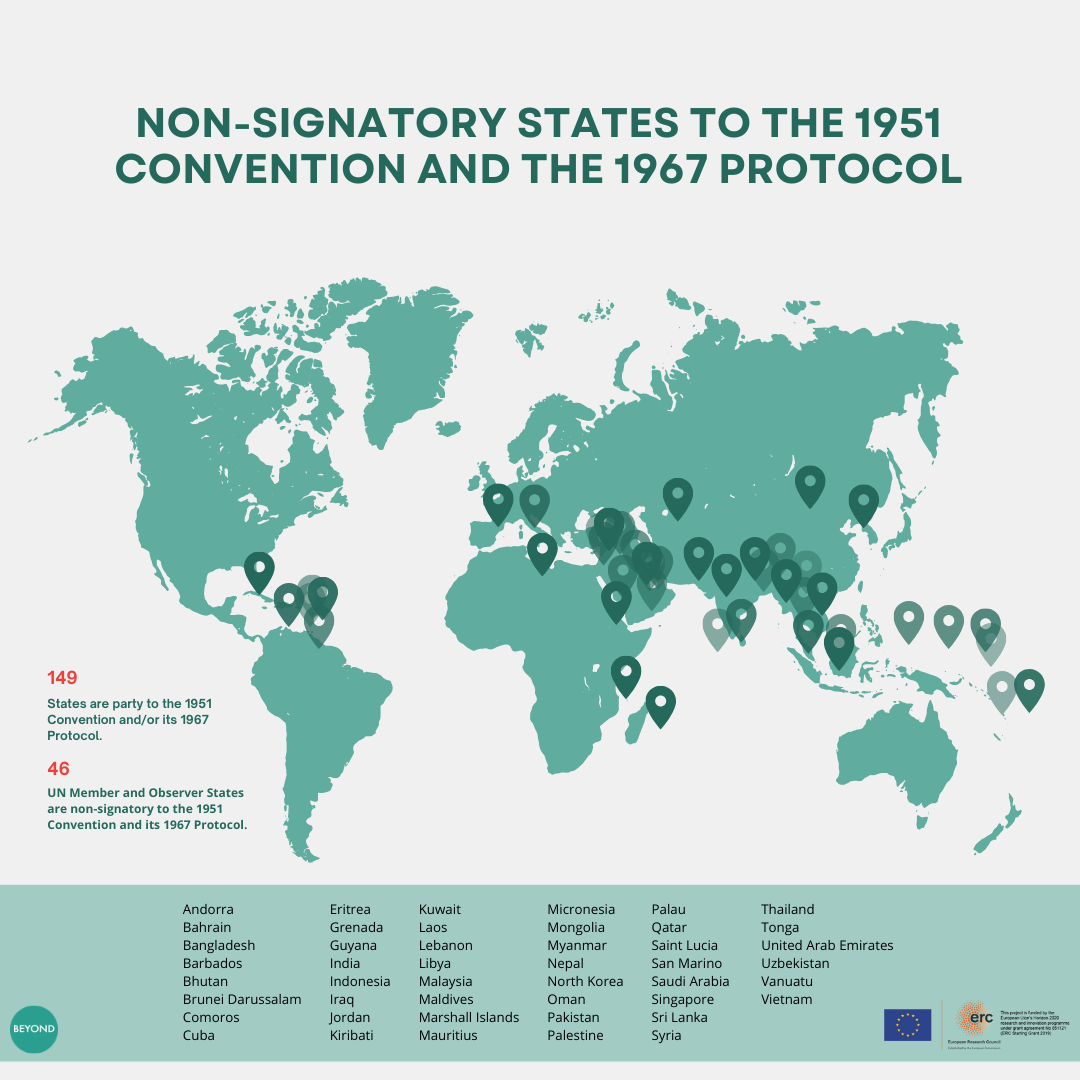
This Convention and its Protocol form the foundations of the international refugee system. While most countries have signed or ratified the two instruments, many important refugee-hosting countries have not. Scholarship has long viewed these states as ‘exceptions’ to international refugee law.
By bringing these states from the margins to the fore, the ERC-funded BEYOND project explores the influence of the 1951 Convention and Protocol in these non-signatory states. It also studies how these non-signatory states engage with and help create the international refugee law regime.
The project focuses on four of the world’s top refugee-hosting states: Bangladesh, Lebanon, Pakistan and Turkey.
Objectives
BEYOND is a European Research Council Starting Grant project, awarded on the basis of 'scientific excellence' as the sole criterion. The ERC supports research of a groundbreaking nature. BEYOND’s overall objective is therefore to reconsider the impact of international refugee law by developing a global and empirically based framework for understanding the behavior and position of states not party to the 1951 Convention.
From this follows BEYOND’s secondary objective: to expose and analyze the various ways non-signatory states relate to the international refugee regime, i.e. the instruments and institutions of refugee protection with the 1951 Convention and the United Nations High Commissioner for Refugees (UNHCR) as cornerstones.
Two overarching questions guide this project:
- What is the influence of the 1951 Refugee Convention in non-signatory states?
- How do these non-signatory states engage with and help create the international refugee law regime?
Sub-projects
BEYOND consists of six inter-related sub-projects aimed at examining the relation between non-signatory states and international refugee law on the global, national and local level.
Sub-project 1 investigates UNHCR’s statutory duty to promote accession to the 1951 Convention and the processes of state ratification, while sub-projects 2-5 are empirical case studies in Turkey, Lebanon, Pakistan and Bangladesh. Sub-project 6 is crosscutting and synthesizes, integrates and conceptualizes the project’s findings in an edited collection aimed at being a key resource in the field of international refugee law.
Watch this interview with BEYOND PI Maja Janmyr to learn more about the project. Film: Jorunn Kanestrøm