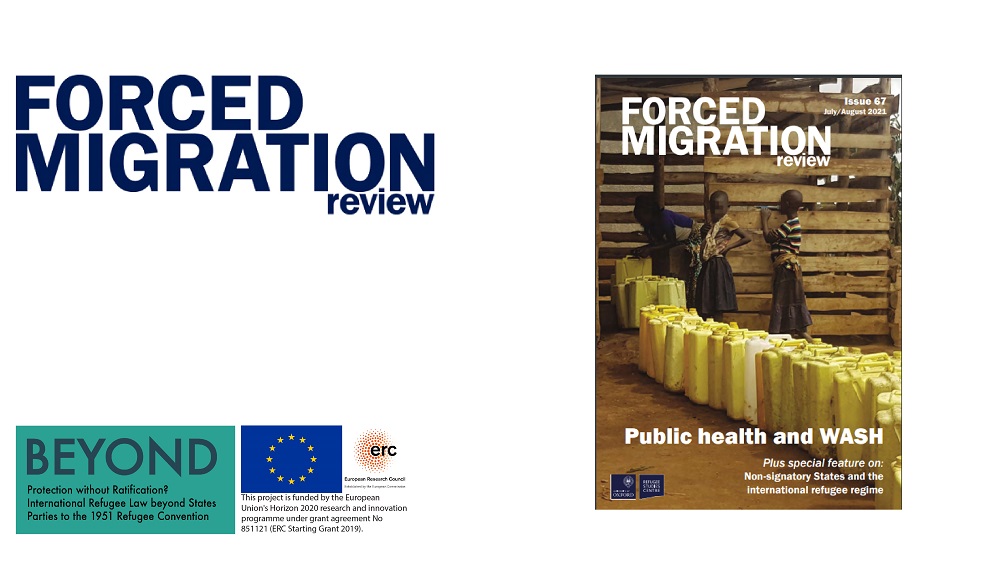
The FMR special feature on non-signatory states is a collaboration between Forced Migration Review and the BEYOND project at the University of Oslo. The 9 articles featured in this issue reflect on the status of refugee protection in non-signatory states and the various ways these states engage with the international refugee regime.
Principal Investigator of the BEYOND project, Professor Maja Janmyr, says that the FMR collaboration has been a great way to start the conversation on questions that are core to the BEYOND project.
- We received a number of excellent contributions from both academics and practitioners, many of whom are based in or have a background from non-signatory countries, says Janmyr
- The articles in this special feature show how non-signatory states interact with the international refugee regime in a range of different ways and thus challenge the prevailing idea that these states are merely exceptions to this regime, Janmyr continues.
In addition to English, the articles in the FMR special feature are published in Arabic, Spanish and French.
- We wanted to collaborate with FMR partly because of their wide readership – among both scholars and practitioners. Having our articles published in several languages allows us to reach readers globally, Janmyr explains.
To celebrate the launch of the special feature, and to take the discussions further, the BEYOND project is organizing two roundtable discussions with FMR special feature authors.
The first launch event, on September 10, focuses on the work of legal aid actors. In this roundtable discussion, the Norwegian Refugee Council, Asylum Access Thailand and Justice Centre Hong Kong share their experiences from providing legal aid to refugees in non-signatory countries. With examples from Lebanon, Jordan, Thailand and Hong Kong, the organizations will discuss which legal instruments they rely on in absence of the Refugee Convention, how they interact with other actors of the international refugee regime such as UNHCR, and which strategies they use to promote and improve refugee protection in the countries they operate.
For more information about the event and registration visit: Legal Aid Beyond the Refugee Convention: Launch of Forced Migration Review special feature on non-signatory states.
The second launch event, on September 17, is a roundtable discussion on the international refugee regime and non-signatory states. Among other issues, the roundtable will discuss how UNHCR is often key in encouraging non-signatory State actors to accept certain international standards, which in turn influences State behavior. Domestic courts also sometimes engage with international refugee law norms and principles, affecting refugees’ and asylum seekers’ access to protection. States’ participation in high-level meetings, forums and agreements such as the Global Compacts is also significant in helping to create soft law obligations that build on the hard law (the Convention) that these States have formally opted out of. Meanwhile, civil society can play an enabling role in many States.
For more information about the event and registration, please visit: The International Refugee Regime and Non-signatory States: Launch of Forced Migration Review special feature on non-signatory states.