Multidisciplinary perspective on pro bono
The central aim of the workshop was to cultivate a collaborative discussion format that bridges the gap between social science, legal research, and legal practice in the realm of pro bono actors and activities. A total of 18 scholars and practitioners participated in the workshop, which was split into six panels over the course of two days, addressing different thematic issues:
- Pro Bono, Professions and Professional Ideals
- Critical Approaches to Pro Bono
- Pro Bono and Justice
- Pro Bono and Consultancies
- Pro Bono and Advocacy
- Pro Bono in Domestic Context
The opening panel kicked off the conversation with theorization and thick descriptions on the role of pro bono as a ritual that produces the special standing of lawyers (Magnus Hannibal Esmark Schrøder) and as a moral counterweight to justify the legal profession (Charles Bosvieux-Onyekwelu). The second panel offered critical reflections on the capitalist motivations underlying (and undermining) corporate pro bono practices (Leigh Rice) and on the effect of processes of autocratization and privatization on big law pro bono (Nina Reiners, continued further below).
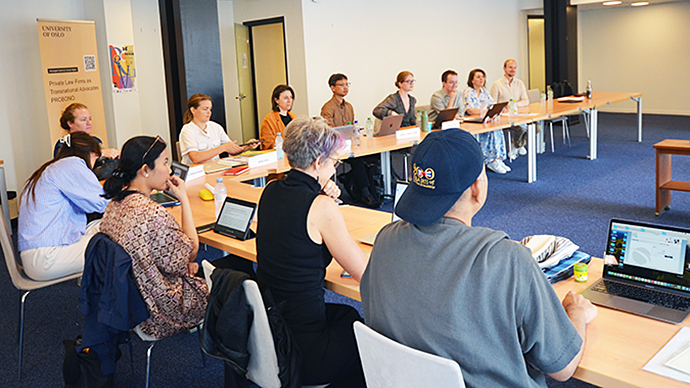
Under the wide scope of the theme “justice,” the third panel addressed the issues of private law firms offering their services in processes of transitional justice (Julia Emtseva) and advocating for Indigenous peoples forcibly displaced by the State (Anna Cichecka), as well as individual lawyers representing cases related to migration control at the European Court of Human Rights (Ezgi Özlü). Rounding off the discussions of day one, the fourth panel explored the role of consulting firms in legal migration processes, including, specifically, in the operationalization of the 2016 EU-Turkey deal (Eleni Karageorgiou) and, more generally, in European migration policies (Lola Avril, continued further below).
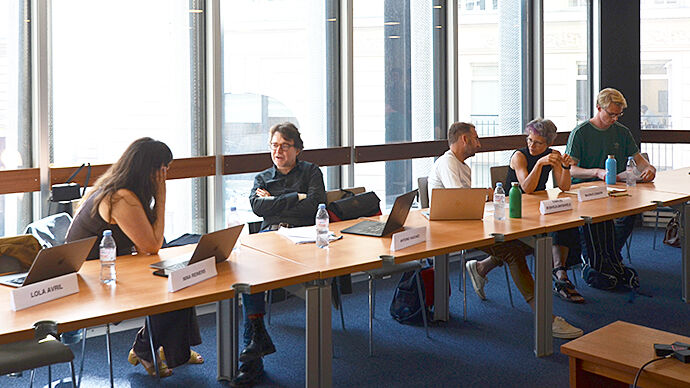
On the workshop’s second day, the panel “Pro Bono and Advocacy” discussed the influence of foundations’ pro bono services on minority rights in Hungary (Alexandra Cosima Budabin), how NGOs navigate shrinking civic space by employing different funding models and registering in multiple legal forms (Nina Hall), and the role of private law firms in global governance (Ellen Vrålstad & Nina Reiners, continued further below). For the final panel, pro bono was explored in domestic contexts, specifically the influence of American and English legal education on pro bono in Southeast Asian legal systems (Tikumporn Rodkhunmuang) and the role of for-profit law firms in Indonesia’s civic and political landscape (Karell Mawla Ibnu Kamali and Kemala Nababan).
Lively discussions
The various backgrounds and expertise of the workshop participants sparked rich discussions and productive insights. The contributions to each panel were assigned a discussant, who provided initial commentary on the papers and presentations, after which other participants offered their thoughts. Discussants included:
- Antoine Vauchez, Professor in Political Sociology and Law and Director of the CESSP (panels one and two)
- Daria Sartori, a human rights lawyer specialized in applications to the European Court of Human Rights (panels three and five)
- Anna Leander, Professor of International Relations/Political Science (panels four and six)
This process meant that all panelists received in-depth and multi-faceted feedback on their research. Panelists were able to hear new perspectives on their work from legal professionals and scholars in other fields, disciplines, or using methodologies other than their own. Consequently, the workshop, with its composite of experts, offered a unique opportunity for the participants to enhance their work by challenging potential assumptions and fostering new lines of inquiry.
“I found the workshop highly relevant. It offered an external perspective on my day-to-day activities and helped me develop a more critical understanding of the environment I operate in,” said Sartori. In a similar vein, Karageorgiou found that the workshop demonstrated approaches to pro bono from disciplines beyond her usual field of law that could be incorporated into her future research.
The discussions questioned both the motives, interests, and methods of various actors’ pro bono activities, with central issues such as accountability deficiencies and access to justice being repeatedly raised throughout the two-day workshop. “I applaud the fact that most of these contributions we have been listening to are not reluctant to being critical towards pro bono work. I think it’s a change in scenery in comparison with the customary music we tend to listen to when it comes to pro bono,” commented Bosvieux-Onyekwelu.
Co-organizers' contributions
PROBONO project leader and workshop co-organizer, Professor Nina Reiners, presented her research paper, “Pro Bono, Anti Bono, and the Authoritarian Challenge”. Following processes of autocratization and privatization globally, private actors, such as law firms, are playing an increasingly significant role in international politics. How do these developments impact big law’s pro bono work? Using empirical examples, Reiners hypothesizes that big law can benefit from the shrinking civic space associated with autocratization. Autocratization “at home,” on the other hand, as seen in the United States under the Trump administration, puts a target on big law’s pro bono work, leading firms to adapt their strategies and allocate resources accordingly.
Junior professor Lola Avril, who co-organized the workshop, offered an intriguing first look at her research on the project “Aux frontières du conseil” (2025-2029) on the role of private consultancies in European migration policies. Seeking to understand how these consulting firms have been able to interfere in policies traditionally associated with state sovereignty, the research is divided into two central strands; The first strand aims to map the dynamics of the border consulting market, including its’ origins and the players involved, while the second focuses on the practices of these consulting firms to understand their involvement in public decision-making. Despite them using the label of pro bono, there is often no clear divide between the firms’ non-commercial and commercial activities.

Ellen Vrålstad, PROBONO research assistant, presented her and Reiners’ paper on pro bono in global governance institutions (GGIs). The paper addresses the under-researched role of private law firms in global governance by mapping these firms’ pro bono engagements with global governance institutions in the past decade. Among other findings, Vrålstad and Reiners demonstrate an increase in this engagement over time, which overwhelmingly centres on the issue areas of human rights, environmental justice, and development. This suggests that private law firms, through their pro bono work, are involved in promoting and developing international norms in these areas.
Concluding and continuing onward
The workshop “When for Profit Goes Pro Bono – Motivations, Practices and Impact” offered a collaborative forum for knowledge exchange between various professions and disciplines. The conversations that followed provided timely insights into the growing role of pro bono actors in a wide range of activities in both domestic and international politics. Co-organizers Lola Avril and Nina Reiners concluded the workshop by thanking all participants and inviting them to extend the synergies arising from the discussions into continued research on pro bono.
Suggesting topics for further inquiries, Leander emphasized the importance of considering the pro bono logic in the context of colonial heritages and pluralistic judicial systems, highlighting the workshop contributions by Rodkhunmuang, Kamali, and Nababan. Vauchez called for more research on how big law firms’ often depoliticized practice of pro bono is evolving in the current “super politicized” period, as characterized by the Trump administration pushing, “if not forcing,” law firms to develop more conservative pro bono practices. Both suggestions involve areas of research that the PROBONO project will explore in future publications.
Organizers
The workshop was co-organized by Nina Reiners, professor at the Norwegian Centre for Human Rights (NCHR) at the University of Oslo (UiO) and principal investigator of the PROBONO project, and Lola Avril, junior professor at the European Centre for Sociology and Political Science (CESSP) at the National Centre for Scientific Research (CNRS) at the Université Paris 1 Panthéon-Sorbonne. The event was hosted in collaboration with the Norwegian University Centre in Paris (CUNP). It was funded by the European Research Council* and by the CNRS Chair REGANET on private actors, regulation, and conflict of interests.
*Funded by the European Union (ERC, “PROBONO – Private Law Firms as Transnational Advocates” (2025-2029), project number 101164875). Views and opinions expressed are, however, those of the author(s) only and do not necessarily reflect those of the European Union or the European Research Council. Neither the European Union nor the granting authority can be held responsible for them.