
ENACT Project summary
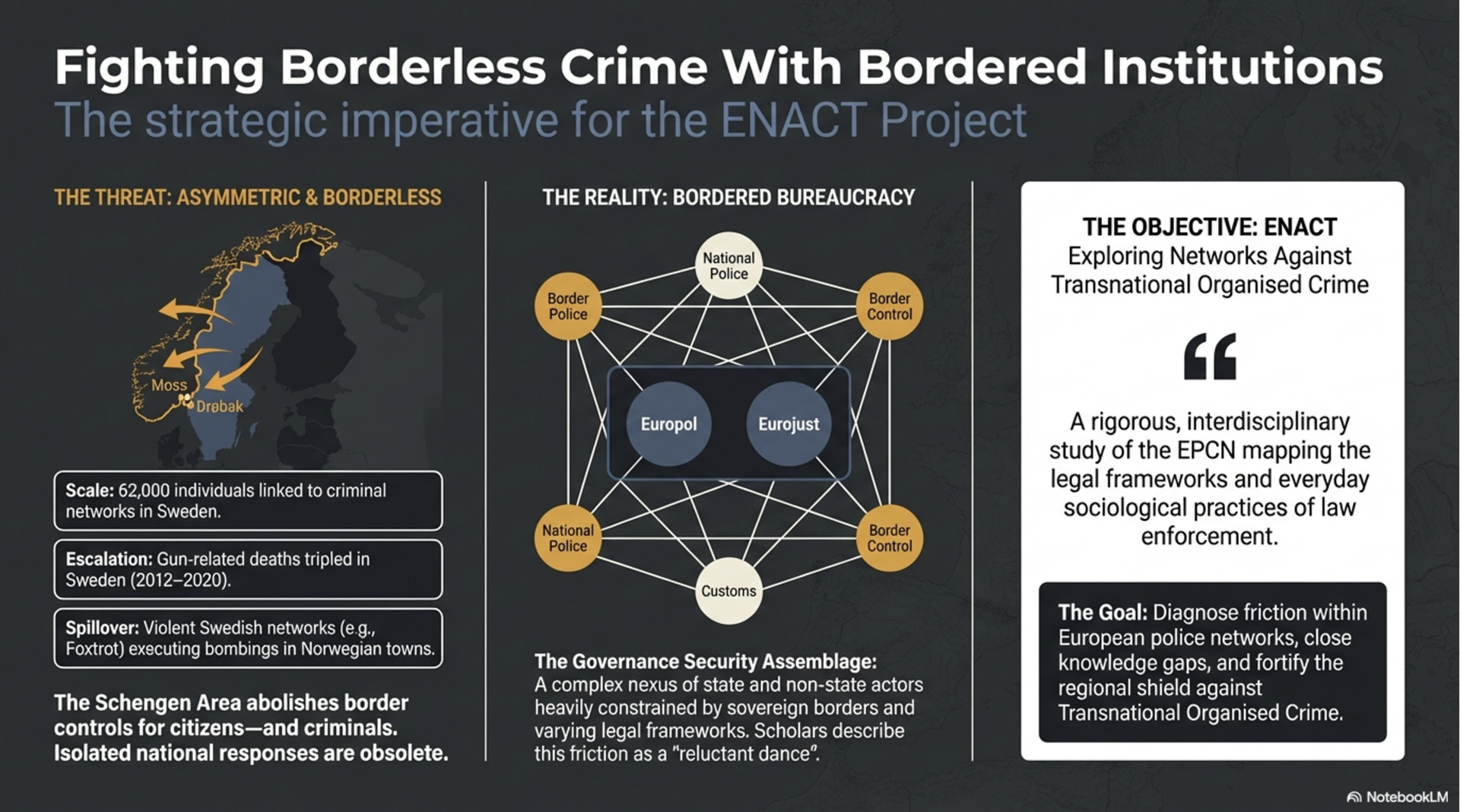
Norway has for decades been closely connected to the EU by the Schengen and the EEA agreements. The lack of internal border controls following Schengen, and the compensatory law enforcement measures have long been a feature of the Norwegian policing landscape.
At the same time, transnational organised crime (TOC) is a severe threat to the Norwegian society. The EU remains very active in developing new law enforcement tools to fight TOC networks that take advantage of the open borders. Norway has access to many EU tools, but not all. Norway is no longer on the periphery of TOC, but risks remaining on the periphery of the network of European police cooperation (EPCN); lacking full policy and legal means to weight in the shaping of new ones as a non-EU member.
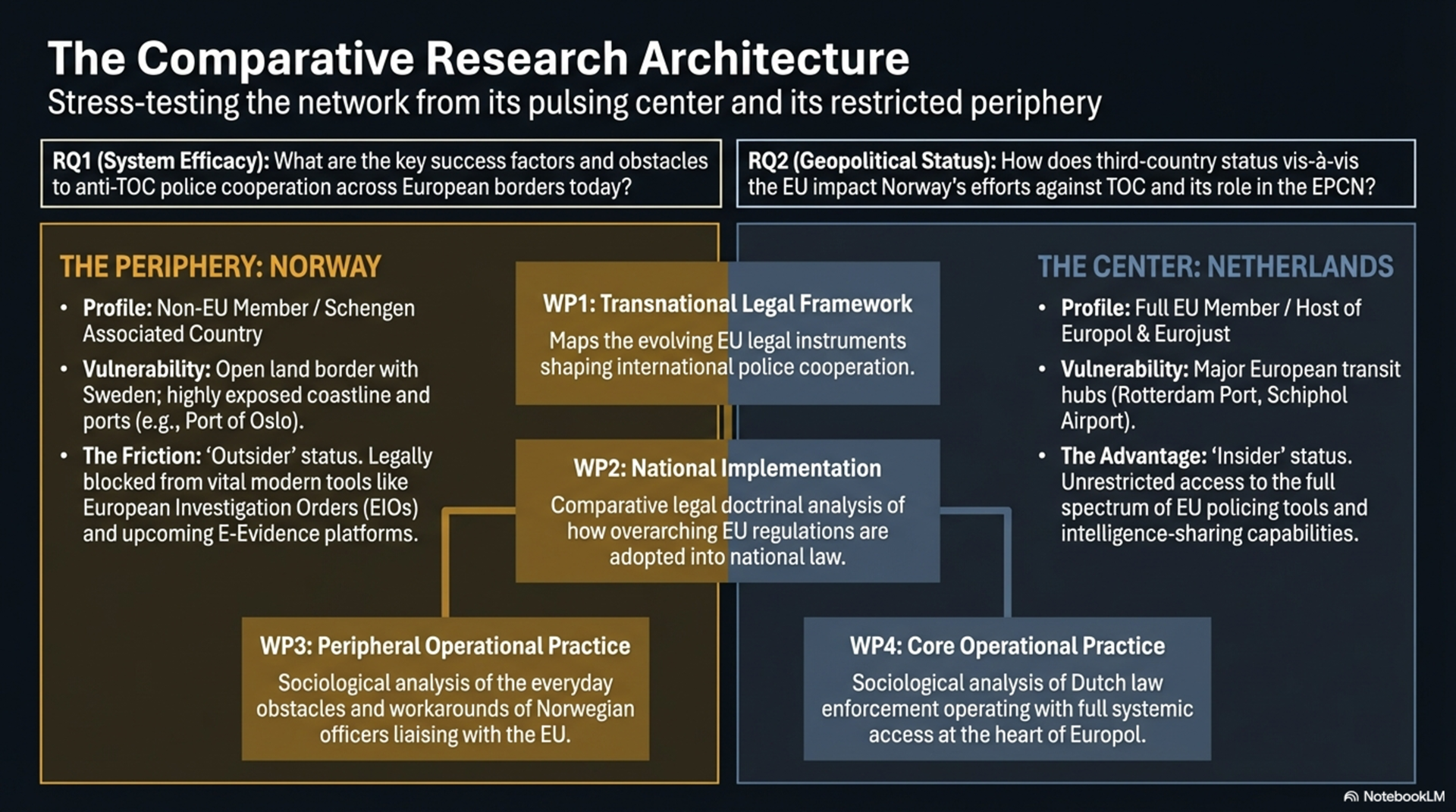
Yet, the politico-legal peripheral position may not explain it all, as countering TOC and making full use of EU tools also may be a challenge within EU, i.e. at the centre of the EPCN. Norway is in the periphery of the European police cooperation network, and the Netherlands in the centre – also when it comes to being a hub for transnational crime.
By examining the cases of Norway and the Netherlands in detail, and combining perspectives from legal doctrinal scholarship with empirical social science, ENACT will provide groundbreaking and unique insights into the everyday challenges of the fight against TOC in Europe today.
Objective
ENACT therefore has a twofold objective:
- To provide understanding of how Norway works with(in) EPCN right now, investigating what works and what does not work, both from a legal and empirical perspective
- What Norway can learn when looking at a more central country still facing similar challenges.
It is an undisputed fact that despite many forms of cooperation and their discoursive/policy and technical support – transnational police cooperation is difficult to enact on the ground. Lack of internal border controls does not explain all, and Norwegian (and EU member states) need to understand why all the efforts done so far do not translate in actual transnational cooperation – and what can be done to improve the situation.
Progress
The PhD position for ENACT had an application deadline in August. A postdoctoral position at Vrije Universiteit Amsterdam will also be advertised, most likely during the autumn.
A tentative kick-off seminar is planned for January 2027.