
The workshop, held on August 18-21 2025, provided a platform for educators across the region to exchange ideas, share best practices, and to enhance their capacity to teach complex human rights issues through an inclusive and intersectional lens.
It attracted 20 lectures from Brunei, Indonesia, Laos, Malaysia, Myanmar, the Philippines, Thailand and Vietnam.
Engaging with recognized scholars in training
The workshop had the honour of hosting internationally and regionally acclaimed scholars. Among these was UN Special Rapporteur on the Right to Development, Professor Surya Deva. He decoded the Right to Development as a fundamental human right that enables every individual and all peoples to participate in, contribute to, and benefit from economic, social, cultural, and political development.
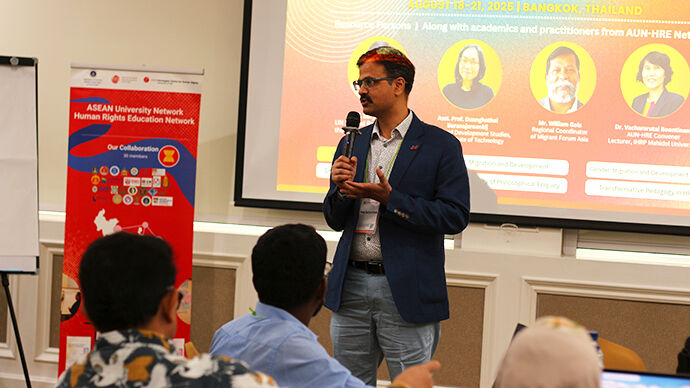
Mr. William Gois, a well-know expert on migration and Regional Coordinator of Migrant Forum in Asia, highlighted the interconnections between the right to development, gender equality, and migration. He analyzed migration governance and unpacked contemporary perceptions of migration.
Additionally, gender expert Dr. Duanghathai Buranajaroenkij from the Asian Institute of Technology explored the dynamics of gender, power, and knowledge production in the context of the right to development and the decision-making process.
Together, these distinguished scholars provided invaluable insights that enriched the dialogue at the workshop and reinforced the importance of integrating various dimensions of human rights in education and policy.

Engaging the participants
The workshop emphasized the importance of active participation and collaboration among trainers and lecturers, establishing a dynamic learning environment. Two trainers from Mahidol University introduced innovative pedagogical tools specifically designed for this. This approach included presentations, discussions, case studies, curriculum design, and group exercises, encouraging participants to share their experiences, contribute ideas, and collaboratively tackle problems. It enhanced the participants' sense of ownership over their learning, and fostered the development of critical and creative thinking, alongside effective problem-solving skills.
The 4-day workshop enabled participants to gain insights into the intersections of gender, development, migration, and human rights. It equipped them with the skills to address the complex challenges faced by marginalized communities, ensuring that human rights education reflects the lived realities across Southeast Asia.