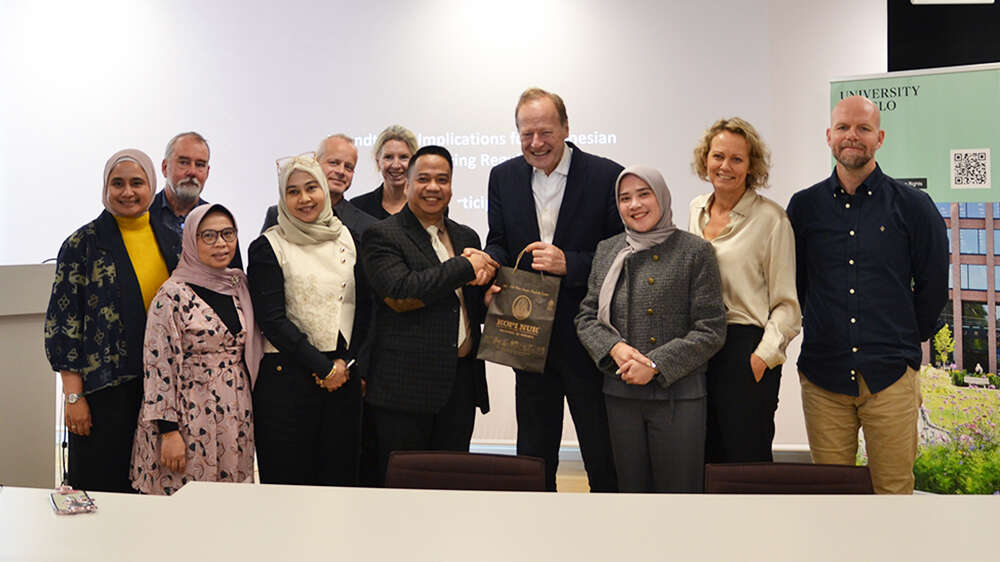
The visit, held on 7-8 September, was conducted in preparation for ongoing legal reforms, in particular the drafting on a new Bill on Business entities and the drafting of implementing regulations for Indonesia’s new Criminal Code and Criminal Procedure Code. The roundtable brought together academics, government officials, private sector and civil society representatives, to exchange experiences on regulatory frameworks governing business enterprises.
The Indonesian delegation was initially supposed to consist of 13 people from the Ministry of Justice, led by Vice Minister of Law Edward Hiariej. However, due to flight cancellations caused by the eruption of Mount Anak Krakatau, only four persons from the ministry were able to attend in person. They were joined by the Indonesian ambassador to Norway and the embassy’s political councillor.
Strengthening the beneficial ownership framework
The first day focused on beneficial ownership and the challenges of effectively designing and applying a regulatory framework.
The Vice Minister joined via video conference and outlined Indonesia’s efforts to strengthen its beneficial ownership framework. He also highlighted the importance of learning from international experiences, including Norway’s approach.
Tobias Brynildsen from the Norwegian Ministry of Finance provided an overview of Norway’s regulatory framework for beneficial ownership. Henning Lauridsen, CEO of Real Estate Norway, provided a private-sector perspective, while Toril Dale, Head of Section at DNB, presented the bank’s work to combat money laundering and other economic crime.
Pia Arntsen from the Brønnøysundregistrene presented Norway’s business registration system. Jonas Veland from the Tax Justice Network discussed the relationship between beneficial ownership and taxation from a civil society perspective.
The afternoon session broadened the discussion to Norway’s international engagement on beneficial ownership. Peter Ringstad from NORAD presented Norway’s international work in this area, followed by Dr Aled Williams from CMI, who discussed comparative experiences in implementing beneficial ownership frameworks. The session concluded with a presentation by Hector Chinchilla from the Norwegian Centre for Tax Research at the Norwegian University of Life Sciences on limitations in existing beneficial ownership frameworks, particularly in relation to identifying hidden ownership and addressing tax evasion.
Investigative interviewing
Asbjørn Rachlew, researcher and retired police superintendent, presented on the topic of investigative interviewing, including Norway’s history of institutional change, as well as global developments. This topic is of huge importance to Indonesia’s new criminal procedure code, which the vice minister has had a key role in designing.
Regulating business entities and corporate criminal liability
The second day focused on the regulation of business entities and corporate criminal liability. The programme brought together Professor Tina Søreide from the Norwegian School of Economics, Professor Mads Andenæs from the University of Oslo, and Marte Voie Opland from the Financial Supervisory Authority of Norway.
Andi Taletting Langi, Director of Business Entities at Indonesia’s Ministry of Law, explained the rationale behind Indonesia’s plans for a new Business Entities Bill.He also highlighted ongoing work to develop implementing regulations concerning corporate criminal liability and non-trial resolution mechanisms.
Professor Tina Søreide addressed three main themes: business regulation and enforcement in high-trust systems, the relationship between administrative and criminal enforcement, and non-trial resolutions. In discussing regulation in high-trust institutions, Søreide emphasised the importance of ensuring that institutional discretion remains accountable.
“Good institutions do not eliminate discretion. They make discretionary decisions explainable, reviewable and contestable.” - Prof. Tina Søreide
She also discussed the respective functions and advantages of administrative and criminal enforcement in regulating business activities, including the importance of coordination between the two systems and making the principle of ultimum remedium operational. Her final presentation examined the balance between cooperation, legitimacy and deterrence in the effective use of non-trial resolutions.
Professor Mads Andenæs examined business regulation from the perspectives of international law and EU/EEA law, as well as their implementation in the Norwegian legal system. He also addressed procedural safeguards relevant to corporate criminal liability, including the protection of whistleblowers.
Marte Voie Opland shared her experience from financial supervision, including the role of the Financial Supervisory Authority in capital market oversight and cooperation between supervisory authorities, the police and prosecutors in combating money laundering.
Learning from each other
The two-day discussion highlighted both the opportunities and challenges of comparative studies. While Norway and Indonesia share many concerns around business transparency, economic crime and human rights protection, differences in institutional structures, regulatory cultures and levels of public trust can influence how particular regulatory approaches operate in practice.
As Andi Langi noted during the discussion, regulatory discretion that works effectively within a high-trust institutional environment may present different challenges when introduced into a lower-trust context. This highlighted the importance of understanding comparative lessons in light of their local context rather than simply transferring regulatory models from one jurisdiction to another.
The discussions demonstrated a shared commitment to strengthening business transparency and human rights protection. Participants emphasised the importance of combining effective regulatory frameworks with institutional capacity and robust procedural safeguards.