UN Department of Peace Operations (DPO)

NCHR cooperates with the UN Department of Peace Operations (DPO) and United Nations Police (UNPOL) on investigative interviewing, as the secretariat for the Doctrine Development Group who developed the UN Manual on Investigative Interviewing.
The collaboration aims to ensure that interviews conducted during peace operations, and by UN staff, is effective and adhere to human rights principles and standards. The NCHR works closely with the DPO and UNPOL to provide guidance, and support to law enforcement agencies, emphasizing the importance of conducting interviews in a fair, impartial, and ethical manner to protect the rights of individuals involved in investigations.
- Related news: Joint United Nations Manual on Investigative Interviewing to Enhance Criminal Investigations validated
UN Office on Drugs and Crime (UNODC)
The cooperation aims to promote best practices in investigative interviewing, ensuring respect for human rights standards. UNODC and NCHR jointly provide training, develop training material, and offer technical assistance to law enforcement and justice officials in UN member states.
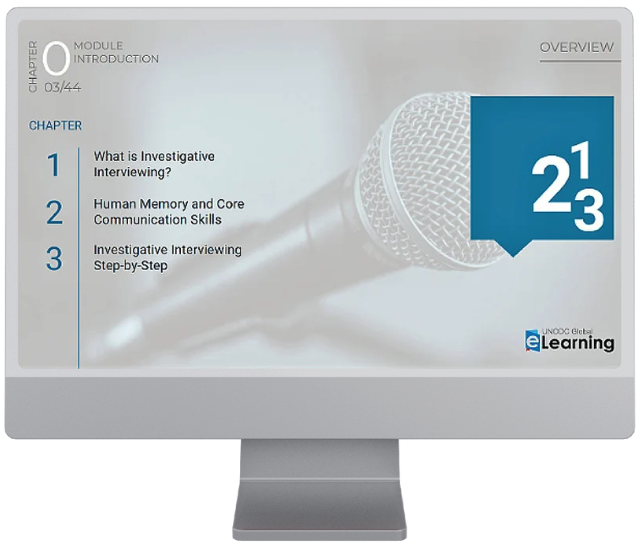
As part of this cooperation, UNODC and NCHR has jointly developed a Global eLearning course on Investigative Interviewing. This free, self-paced interactive course aims to engage users through exercises, videos and quizzes. The eLearning course provides a solid foundation for comprehensive training on conducting investigative interviews. Upon completing all modules, users can receive a certificate. Additional modules on Human Memory and Communication are also available.
The eLearning Course is available in six languages. English, Arabic, French, German, Russian, Spanish, Thai, and forthcoming in Ukrainian language.
- Read more: about the eLearning course.
Global network and the "Méndez Principles"
NCHR also cooperate with a number of international organisations on crime prevention and anti-torture initiatives, including with the Centre for Human Rights and International Humanitarian Law, American University Washington College of Law and the Association for the Prevention of Torture as part of the secretariat for the Principles on Effective Interviewing for Investigations and Information Gathering.
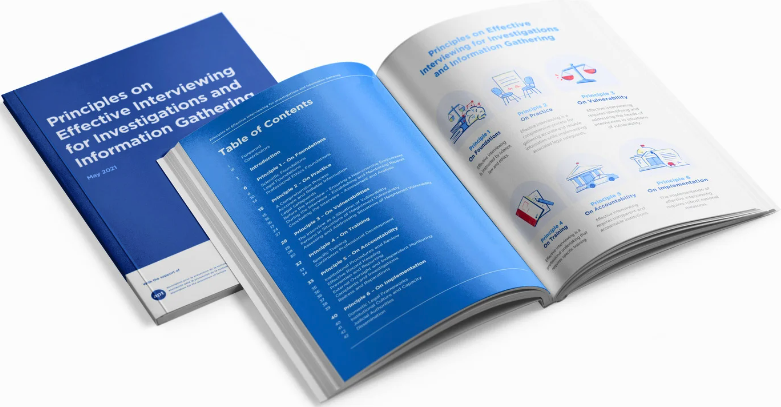
The principles, commonly known as the “Méndez Principles” propose a concrete alternative to interrogation methods that rely on coercion to extract confessions. Tailored towards policy- and decision makers, they provide guidance on obtaining accurate and reliable information in full respect of the human rights and dignity of all, including through the implementation of legal and procedural safeguards in the first hours of police custody. The Principles are Available in 15 languages.
The Investigative Interviewing Summary Checklist

Peer-reviewed by leading experts in the field of investigative interviewing, this tool aims to uphold both effectiveness and ethical standards in investigations, making it an essential resource for professionals and students alike. This checklist is designed for those familiar with investigative interviewing. Limited in its format (only 1 page), it should serve as a visual reminder to ensure critical steps and considerations are remembered and followed.
"Having a checklist like this is a central pillar in ensuring that effective interviewing practice is maintained and implemented across the globe. A handy reminder for all; those new to this way of working and those seasoned with using appropriate practice—everyone needs a clear user-friendly guide." — Professor Rebecca (Becky) Milne.
The checklist is available in English and Portuguese, and forthcoming in Icelandic, Ukrainian and Norwegian.
Vulnerability guidelines
When conducting interviews, police officers frequently encounter individuals who may be considered vulnerable. Some of these individuals face specific challenges that must be carefully addressed to ensure they are not placed at further risk and are able to fully exercise their procedural rights.
Interviewers must work carefully—through preparation and rapport building – and indeed before, during and after the interview - to reduce the impact of these vulnerabilities and create the safest and most supportive interview environment possible.

The guidelines for assessing vulnerability during criminal investigations, police interviews and criminal proceedings are designed as a practical tool to assist police officers and other professionals who conduct interviews. The guidelines were originally developed for Belgian defence lawyers by Professor Lore Mergaerts (KU Leuven).
These guidelines aim to deepen understanding of what vulnerability entails and how it may present itself in an interview context. They may support interviewers in identifying potential vulnerabilities - but more importantly - they can serve as a learning tool giving some substance to the issue of vulnerability.
Additional resources
- Set universal standards for interviewing detainees without coercion, UN anti-torture expert urges States
- International Covenant on Civil and Political Rights (Article 14 Right to a fair trial)
- Convention against Torture and Other Cruel, Inhuman or Degrading Treatment or Punishment (CAT)
- Investigative Interviewing for Criminal Cases, CTI training tools 1/2017
- A brief introduction to investigative interviewing - A practitioner’s guide, published by Council of Europe
- Investigative Interviewing: the Literature by Mary Schollum, Office of the Commissioner New Zealand Police
All these tool and resources align with the ethos of Investigative interviewing, a non-coercive, research-based, human rights compliant and effective method for interviewing victims, witnesses, and suspects. It provides police and intelligence officers with reliable, accurate and actionable information. In criminal investigations it contributes to retrive evidence that stand the test of trial. In addition, long-term positive effects include de-escalation of violence; improved background intelligence; trust building between law enforcement and citizens; and in turn enhanced state legitimacy.
New tools and resources