
Ms. Lawlor has been at the forefront of advocacy for human rights defenders at risk since assuming her mandate on May 1, 2020. With over four decades of impactful experience in human rights advocacy, Ms. Lawlor has dedicated her career to championing internationally recognised human rights and those who courageously protect them.
Joining the conversation was Sandra Petersen, Doctoral Research Fellow at the Norwegian Centre for Human Rights (NCHR) and Special Advisor to the Norwegian Human Rights Fund (NHRF).

Both the captivated audience and the organizers were delighted at the opportunity to listen and learn, and to honour the work of the UN special rapporteur.
Thought-provoking insights
From the very beginning of the event, it was clear that many were eager to learn from Ms. Lawlor – there was barely a chair left in the room, and the audience listened intently as she reflected on her journey.
Throughout the conversation, the discussion covered various complexities and challenges Ms. Lawlor has faced in her role as UN Special Rapporteur. The audience was given a glimpse into her daily work, with insights into strategies and steps used strengthen the protection of human rights defenders (HRDs) and navigate the evolving landscape of their advocacy.
Building relationships with UN member states is integral to the work of the Special Rapporteur. “It is important to establish connections and understand what you can expect from them,” Lawlor emphasized. And she operates on a basis of mutual respect: “I respect the expertise of diplomats, just as I expect them to respect mine.”
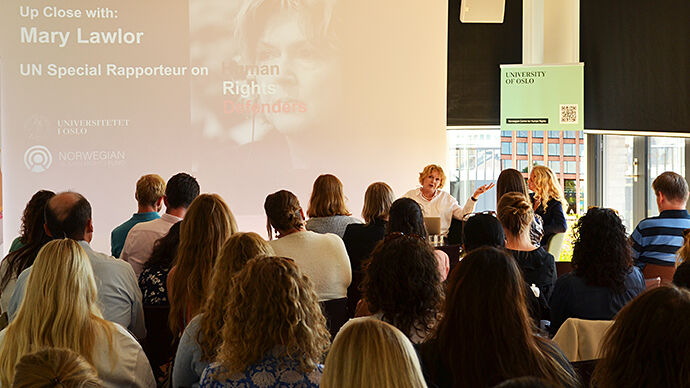
Tactics like naming and shaming have their place and can be very effective, but it should be balanced with recognition, Lawlor said. Maybe "carrot and stick" is a better way of putting it. For instance, she highlighted that she makes a point to always acknowledge when defenders in long-term detention are released. Her team is currently following 90 imprisoned human rights defenders serving ten years or more, but she highlights every release when she engages with States.
Learning opportunities
In addition to sharing a wide range of successes the Special Rapporteur has accomplished since assuming her mandate in 2020, Ms. Lawlor also shared some more challenging moments – and what she learned from them. She mentioned a specific incident where she was navigating what she could and could not do within her mandate, and later wished she’d listened instead of spoken. High-pressure settings can be complicated, she pointed out, but you can take much learning away from these experiences.
The honesty and sincerity of her answers seemed to resonate with the audience, several of whom later said they admired the way she opened the space for evolution, learning and growth.
Student engagement
Students should not be underestimated, Ms. Lawlor believes – arguing that their enthusiasm, potential, and ideas can be invaluable. “I love seeing students,” she said. “They come up with good, practical, lateral strategies.” She encouraged the students in the audience to use their skills and knowledge to contribute to efforts to protect human rights defenders.
The UN Special Rapporteur has hosted several NCHR interns over the year, and Ms. Lawlor is interested in continuing the collaboration with UiO students. She wants to see initiatives from students, and expressed interest in having a working/protection group at the university focusing on long-term detention cases.

Building momentum
Rounding out the event, Ms. Petersen turned the discussion towards the future. What message, if anything, would Ms. Lawlor like to convey to the Norwegian audience?
For one, the Norwegian public should be aware of the positive role Norway plays internationally on HRDs, she says. “I don’t think the Norwegian public realizes the power and influence Norway has on other countries. But the public must also recognize that the government has a responsibility to push for human rights and support human rights defenders.” In general, Norwegian society is good in this regard, she argues – NGOs and other actors are very active. Still, she believes, it is very important that the Norwegian state and its Ministry of Foreign Affairs also continue supporting these efforts.
Aditionally? She’d like to highlight the importance of community. “My biggest achievement is the team I have,” Ms. Lawlor said. “You can’t do things unless you have people who work hard.” She encouraged the audience to start with their own community and build momentum from there.
And finally, she urged the audience to remember the importance of continued, dedicated work:
“Small victories keep us going.”
About the event
The event was co-hosted by the NHRF and the NCHR, aiming to bring an enlightening discussion about human rights defence, advocacy and protection.