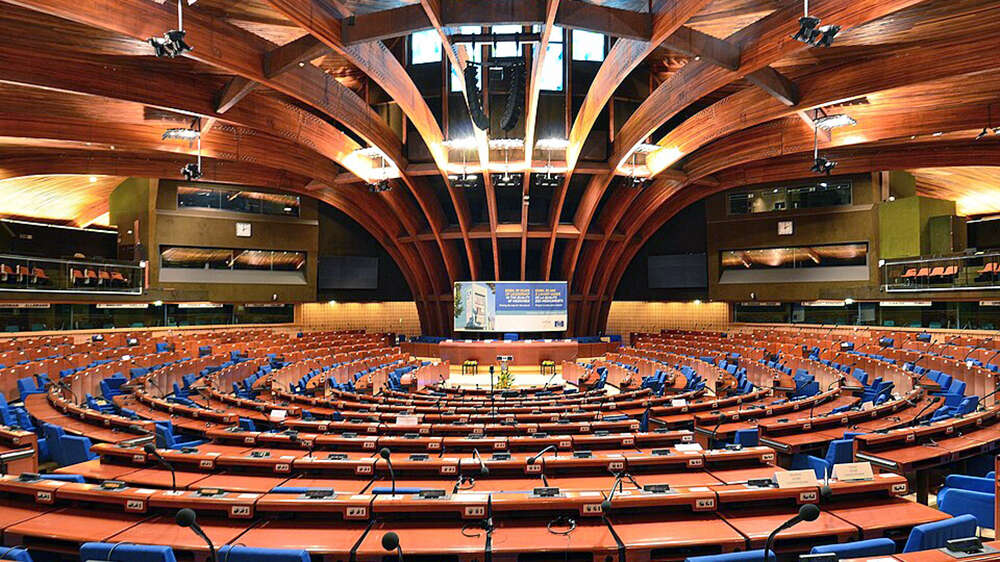

The report, which was written for the Congress of Local and Regional Authorities at the Council of Europe (CoE), was examined in a plenary session in Strasbourg this April. It provided the basis for a resolution and a recommendation [CG(2026)50-15]. Both of these were adopted by the Congress.
The meeting report outlines: After hearing a statement of the President of the European Court of Human Rights, Mattias Guyomar, the Congress held a debate and adopted Recommendation 548 (2026) and Resolution 526 (2026) “Implementation of the European Convention on Human Rights by local and regional authorities: lessons from the case law of the European Court of Human Rights”.
The recommendation and resolution were presented by co-rapporteurs Gudrun Mosler-Törnström (Austria) and Mélanie Lepoultier (France).
You can read the full meeting report here.
Contributing to the New Democratic Pact for Europe
The session was introduced by the President of the ECtHR: Speech by Mattias Guyomar at the 50th session of the Congress of Local and Regional Authorities – 2 April 2026 (French and English).
This body of work is a contribution to the New Democratic Pact for Europe, where the CoE unites with its partners to boost solutions to issues that undermine democracy in Europe. It "serves as a collective and inclusive process," CoE says on their webpage, which is not meant to reinvent democracy, but to "reinforce its foundations, amplify its benefits, and innovate its form to make it tangible for everyone, especially younger generations."
All Council of Europe bodies are currently mobilising their capacities and networks to contribute throughout the pilot phase, until the end of 2026, and to help shape the Pact’s long-term direction beyond it.