.jpg)
About the PhD Course
This PhD course focused on the domestic impact of international and regional human rights instruments and mechanisms. Various studies on this broad topic have tried to find out whether these instruments and mechanisms make a difference concerning the human rights situation on the ground. Debates on domestic impact are informed by various disciplines, including law and political sciences, and require mixed methods that combine at least qualitative and quantitative approaches.
The human rights instruments covered under the course fell under three broad categories:
- The nine core UN human rights treaties
- The regional human rights treaties, primarily the European and the African ones
- Important human rights resolutions or instruments, such as the Universal Declaration on Human Rights, the UN Declaration on the Rights of Indigenous Peoples (UNDRIP), the UN Declaration on the Rights of Peasants (UNDROP) and the UN Guiding Principles on Business and Human Rights (UNGP).
That said, the main focus rested on exploring the domestic impact of the nine core UN human rights treaties and the European and African regional human rights treaties. The course program also included insights on the domestic impact of regional and international human rights law and mechanisms in Norway, Ethiopia, and Bosnia and Herzegovina.
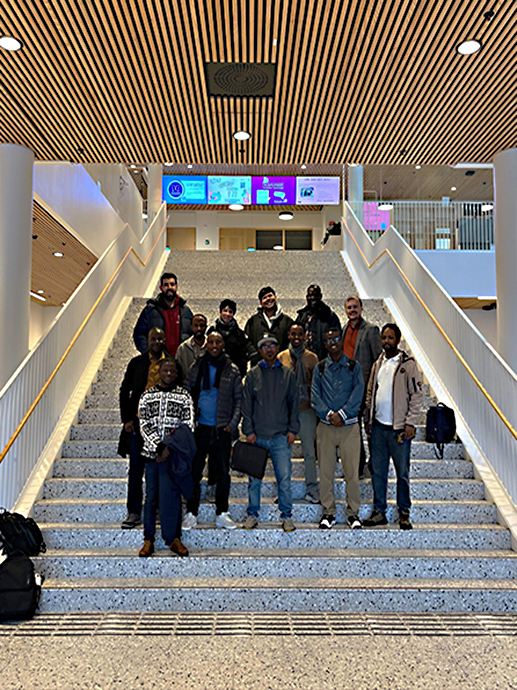 Participants
We had 16 participants, most of whom attended in person. Of them, 11 were from our Norhed project partner institutions: Mekelle University in Ethiopia, Makerere University in Uganda, the African School of Economics (ASE) in Benin, and Universidad de los Andes in Colombia. Additionally, we welcomed participants from Indonesia, South Africa, Thailand, Iran, Nepal, and Egypt.
Lectures and organizers
Various issues were covered in two and a half days through mainly in-person lectures and seminars taught by renowned experts in the field, including Cecilia Bailliet, Vibeke Blaker Strand, Christina Voigt, Frans Viljoen, Mekonnen Fisseha, Nedim Hogic, Gabriel Toggenburg, Kristin Høgdahl, and Gentian Zyberi. The course was accredited for 4 (four) ECTS study points. The assessment of course participants was based on a written essay, graded pass-fail. Course participants got an attendance certificate. Katarina Lavrinenko Friis-Olsen and Adèle Guers facilitated the course.