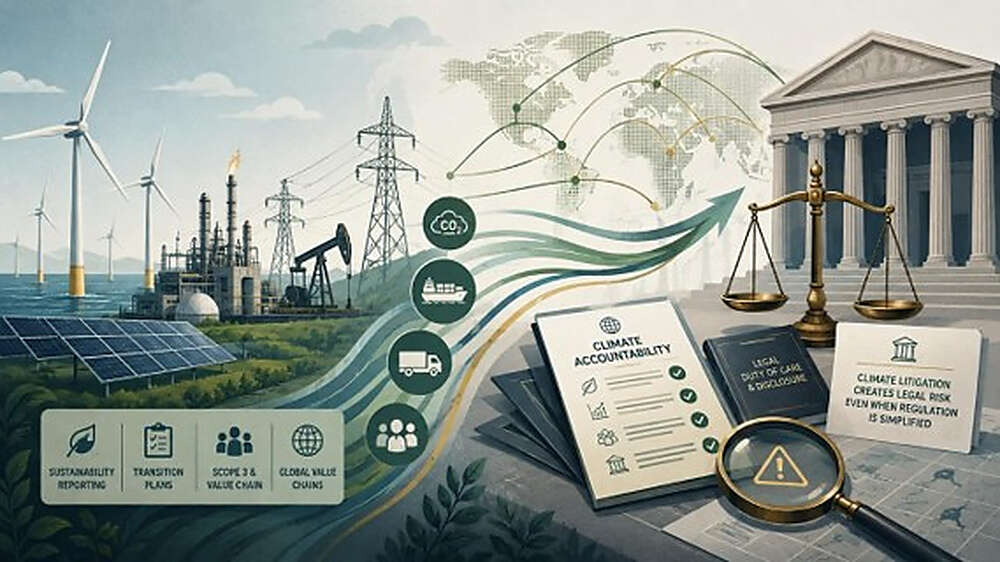
For an energy company, winning a climate lawsuit does not necessarily mean that nothing has changed. The company may have spent years defending its strategy, opened its internal climate policies to judicial scrutiny, faced questions from investors and the public, or even delayed a project while the case was pending. Climate litigation is therefore becoming more than a question of who wins or loses in court. It is becoming a business risk.
This matters at a particularly interesting moment in Europe. In February 2026, the European Union adopted the Omnibus I Directive, which amended both the Corporate Sustainability Reporting Directive (CSRD) and the Corporate Sustainability Due Diligence Directive (CSDDD). The reforms indicate part of the European Union's effort to simplify corporate sustainability requirements and reduce regulatory burdens.
But does less regulatory burden also mean less legal risk?
For energy companies, the answer may be more complicated.
What Companies Say Can Become Evidence
Corporate sustainability reporting can easily be seen as a compliance exercise. A company reports its emissions, climate risks and sustainability target, publishes the information, and moves on.
However, climate litigation is challenging that assumption.
Statements about net zero, carbon neutrality, emissions reductions or alignment with the Paris Agreement can later be compared with what a company is actually doing. Its investment decisions, fossil fuel projects, emissions trajectory and transition strategy may all become relevant when courts examine corporate climate conduct.
This creates a simple but important risk: sustainability disclosure can become evidence.
The risk is not limited to inaccurate numbers. Courts may also be asked to consider whether a company's public climate narrative is consistent with its actual business strategy.
There is evidence that such litigation can have financial consequences. A study highlighted by the Grantham Research Institute at the London School of Economics examined 108 climate lawsuits against listed companies in the United States and in Europe between 2005 and 2021. It found that climate case filings or unfavourable decisions were followed, on average, by a 0.41 per cent fall in stock returns. The effects were larger for major carbon emitters.
Litigation risk is, therefore, not only a lawyer's problem.
A Company Can Win and Still Face Risk
The litigation brought by Milieudefensie (Friends of the Earth Netherlands),together with Greenpeace Nederland, Fossielvrij NL, Waddenvereniging, Both ENDS, Jongeren Milieu Actief, ActionAid, and 17,379 individual claimants, against Royal Dutch Shell plc illustrates this well.
In 2021, the District Court of The Hague ordered Shell to reduce emissions associated with the Shell group by 45 per cent by 2030 compared with 2019. The order covered direct emissions as well as emissions associated with energy products sold by the group.
In November 2024, the Court of Appeal overturned that specific reduction order. Yet it did not conclude that Shell had no climate responsibility. The court stated that Shell has an obligation to counter dangerous climate change, while finding that it could not impose the particular 45 per cent reduction standard, or another specific percentage, on the company.
Shell therefore succeeded on appeal. Yet the litigation continued to subject its transition strategy, direct emissions and value-chain emissions to extensive judicial scrutiny. Importantly, the case did not end with the 2024 appellate judgment. Milieudefensie and the other claimant organisations subsequently brought an appeal in cassation before the Dutch Supreme Court in February 2025, challenging the Court of Appeal’s refusal to impose a specific emissions-reduction obligation on Shell. The Supreme Court heard oral arguments in May 2026, and the proceedings remain ongoing.
That distinction matters. Legal risk should not be measured only by damages or final defeat in court. Litigation can place corporate strategy under legal scrutiny even when the defendant eventually wins.
The Value Chain Is Moving into the Courtroom
A more recent case involving TotalEnergies makes the value-chain dimension even clearer.
In June 2026, the Paris Judicial Court ruled in proceedings concerning TotalEnergies under the French duty of vigilance law. According to the ruling, the court found the company's vigilance plan incomplete because its risk mapping included direct operational emissions, known as Scope 1 and Scope 2 emissions, but excluded Scope 3 emissions, which are indirect emissions arising across a company's wider value chain, including from the eventual use of the products it sells.
The court ordered TotalEnergies to supplement its vigilance plan within six months by including those emissions in its climate-risk mapping and related vigilance measures. However, it did not order the company to stop new oil and gas projects or impose a specific emissions-reduction pathway.
TotalEnergies has appealed. In its official statement announcing the appeal, the company argues, among other things, that the activities of customers over which it has no control should not fall within the scope of the French duty of vigilance law.
Despite the final outcome, the dispute illustrates a broader development: the legal boundary of a company is not necessarily the boundary of its climate risk.
Risk Beyond the Defendant
Climate litigation against Shell, TotalEnergies and other energy companies has implications beyond the individual defendants. Once courts begin scrutinising transition plans, Scope 3 emissions, climate claims or value-chain practices, similar companies may face comparable arguments in future cases. The Global Trends in Climate Change Litigation 2026 report shows that corporate climate litigation continues to expand and diversify.
For energy companies, these cases can therefore serve as early warning signals. Even unsuccessful claims may reveal which evidence courts consider relevant, expose weaknesses in corporate climate strategies, or provide legal pathways for future claimants.
The practical lesson is simple: energy companies should not wait until they are sued to treat climate litigation as a legal risk. Cases against competitors can serve as early warning signals, revealing which corporate statements, transition plans and value-chain practices may become the next focus of judicial scrutiny. Regulatory simplification may reduce compliance obligations, but it does not necessarily make those risks disappear. Sometimes, the risk simply moves somewhere else.
*******************
This blog post is based on the paper presented at the conference Sustainability Law: Law’s Response to the Convergence of Crises, 16-18 September 2026, at the University of Oslo