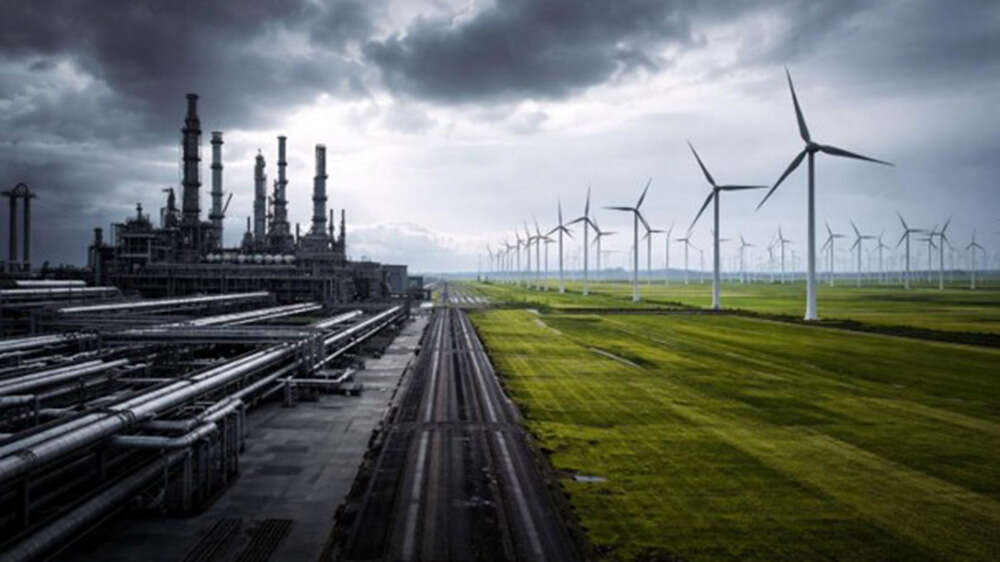
Can a petroleum company promise a carbon neutral future while continuing to produce fossil fuels? As the global energy transition accelerates, petroleum companies face growing pressure to demonstrate credible climate strategies. Many firms, including Equinor, have announced ambitious net-zero commitments, yet these promises are often met with scepticism as fossil fuel production continues alongside sustainability pledges.
This blog post explores whether Equinor’s climate commitments reflect a genuine transition strategy or whether they function more as a sustainability narrative aimed at maintaining legitimacy while continuing with business as usual.
EU Sustainability Regulations and International Norms
International norms and EU sustainability initiatives have significantly influenced European corporations to adopt more environmentally and socially responsible business practices. In addition to the much discussed Paris Agreement on Climate Change, the OECD Guidelines for Multinational Enterprises on Responsible Business Practices (OECD Guidelines) and the United Nations Guiding Principles on Business and Human Rights (UNGPs) are potentially groundbreaking norms that have been incorporated into practice and legislation at both the corporate and EU levels.
The OECD Guidelines are government-backed recommendations for multinational enterprises that promote ethical corporate conduct through human rights, labour, environment and governance principles and standards. The UNGPs provide recommendations for states and businesses, distinguishing between the state duty to protect human rights and the corporate responsibility to respect them.
At the heart of both the OECD Guidelines and the UNGPs is the principle of risk-based due diligence. This means identifying, preventing, mitigating and accounting for the actual and potential impacts of business activities, whether under the OECD guidelines or the UNGPs. Both the OECD Guidelines and the UNGPs are referenced in and provide the guiding framework for EU legislative instruments. These instruments include the Corporate Sustainability Reporting Directive and the European Sustainability Reporting Standards, which require companies within their scope to report on environmental and human rights impacts, as well as the Corporate Sustainability Due Diligence Directive, which will move corporate action beyond passive reporting by requiring active risk-based due diligence.
In its Annual Report 2025, Equinor states that its sustainability reporting and due diligence are aligned with these international frameworks.
Equinor’s Energy Transition Plan in a Nutshell
Equinor presents its Energy Transition Plan as a roadmap toward net zero by 2050. According to the company’s 2025 Annual Report, this strategy rests on three pillars: optimisation of oil and gas production, profitable growth in renewable energy, and investment in emerging low-carbon technologies such as carbon capture and storage.
At the heart of the strategy is a continued focus on optimising oil and gas production. This approach focuses on making continued extraction more efficient, more competitive and less carbon intensive, rather than emphasising a gradual shift away from fossil fuels.
While the company highlights ambitions to reduce emissions and expand its renewable portfolio, the boundaries of these commitments are framed within the requirement of profitability. This became particularly evident when Equinor’s CEO, Anders Opedal, acknowledged that Equinor has not actively pursued its renewable energy targets for several years because too few projects met the company’s investment requirements. Offshore wind has been positioned as a key pillar of Equinor’s transition strategy, yet political and economic challenges in wind markets have led Equinor to rein in its ambitions. In 2026, Equinor also reduced its net carbon intensity ambitions for 2030 and 2035, while maintaining its net-zero ambition for 2050.
When renewable investment plans are scaled back because projects fail to meet expected returns, sustainability begins to look less like a long-term commitment and more like a conditional business strategy.
The same pattern can be seen in Equinor’s investments in solar energy projects, which are pursued in selected markets where such projects are commercially attractive and practically feasible. This raises an important question: if the transition away from fossil fuels only progresses when market conditions are favourable, can it truly be described as a genuine change?
Reducing emissions is an important step toward carbon neutrality, but it is not sufficient to achieve it on its own. If oil and gas extraction remains the foundation of Equinor’s business model, claims of sustainability can appear more like adaptation to market pressures than a structural shift in strategy.
Equinor’s emissions targets are also ambitious on paper. The company aims to achieve net zero by 2050 across Scope 1, 2 and relevant Scope 3 emissions, including emissions from the use of the energy products it produces. Scope 1 covers direct emissions from owned or controlled sources, scope 2 covers indirect emissions from purchased energy and scope 3 includes all other indirect emissions across the value chain, such as suppliers and product use. Scope 3 emissions are of special significance in the oil and gas industry because they include consumer emissions that fall outside of direct company control.
Despite these targets, the scale of Equinor’s current energy mix of fossil fuels and renewables highlights the difficulty of achieving meaningful transformation. In 2025, Equinor’s reported energy production from its own operations amounted to approximately 1,231 terawatt-hours (TWh) from oil and gas compared to around 3.5 TWh of renewable energy delivered to the grid. Renewables therefore account for only about 0.3 per cent of the reported energy production. Against this backdrop, carbon capture and storage is presented as an important tool for meeting long-term sustainability targets.
Finally, the Energy Transition Plan has concrete action strategies for reaching specific benchmarks by 2035. After this date, the plan remains vague and uncertain as to how Equinor intends to achieve net zero.
The Possible Impacts and Defects of this Plan
Equinor’s ambition to become net zero by 2050 appears, on the face of it, to be a major commitment for a company operating in a carbon-intensive industry. However, the broader issue is whether net zero can realistically and meaningfully be achieved while continuing oil and gas production, and whether the methods proposed by the company lead to actual sustainability.
Reductions in carbon emissions play a crucial role in trying to limit the effects of climate change. Yet, climate change represents only one of nine planetary boundaries that environmental science research has indicated as crucial to human existence on the planet. Carbon emissions are thus one piece of the larger environmental puzzle that companies should address. An environmental transition plan therefore needs to include not only carbon neutrality, or better, contributing to the mitigation of climate change, but also measures addressing the other eight planetary boundaries to promote environmental sustainability.
This broader perspective is particularly relevant to Equinor’s reliance on carbon capture and storage. While the technology can capture and store emissions, it carries environmental and health risks, including potential leaks during transport that may cause asphyxiation or marine acidification. Underground storage may also result in leakage, water contamination, or induced seismic activity. Therefore, carbon capture remains a potentially risky tool that can be used to compensate for continued emissions rather than reducing dependence on fossil fuels. This can enable ‘business as usual’ instead of a structural shift away from oil and gas.
Perhaps the most significant weakness in Equinor’s transition plan lies in its treatment of scope 3 emissions. Although scope 3 emissions include emissions resulting from the use of a company’s products, Equinor’s plans for scope 3 emissions, according to its Energy Transition Plan, rely on a net carbon intensity metric rather than an absolute reduction target, including measures such as carbon capture and storage and renewable energy production. Clearly, energy production is a major source of carbon emissions through global energy production, and such emissions need to be reduced. However, scope 3 emissions from oil and gas extend beyond emissions generated by the energy sector itself to other industries and everyday use. Failing to set an absolute reduction target for these downstream emissions raises questions about whether Equinor’s net-zero strategy sufficiently addresses the full impact of its business practices.
Rethinking Equinor’s Path to Sustainability
If Equinor aims to make its business practices environmentally sustainable, several changes to its transition plan are necessary. First, Equinor needs to shift away from oil and gas towards renewable energy production. Second, carbon capture should only serve as a short-term measure, in a transition period while renewable energy production increasingly replaces oil and gas. Finally, the plan’s scope should more systematically address other relevant planetary boundaries beyond climate change.
If these changes are implemented, Equinor’s pathway toward environmental sustainability could become clearer and more convincing, bringing the company closer to a genuine environmental transition.