A forest can be protected by a fence, a park boundary, or a government agency. But in the Amazon, one of the most effective forms of protection is also a legal right: the right of Indigenous Peoples to their territories.
Brazil’s 1988 Federal Constitution marked a decisive break with earlier assimilationist policies. It recognised Indigenous Peoples as collective rights-holders and recognised their original rights to the lands they traditionally occupy. These are not rights granted by the State as a favour. They are rights that the Constitution understands as existing prior to the formation of the Brazilian State.
This constitutional choice matters far beyond Brazil’s Indigenous communities. It matters for forests, biodiversity and the climate.
A constitutional shift — from assimilation to recognition
For much of Brazil’s history, State policy treated Indigenous peoples as groups that should eventually be integrated into the dominant society. The 1988 Constitution changed that paradigm. Article 231 of the Constitution recognises Indigenous social organisation, customs, languages, beliefs and traditions, as well as their original rights to traditionally occupied lands.
The Constitution also defines these lands in ecological and cultural terms. Traditionally occupied territories include areas necessary for productive activities, such as hunting, fishing, gathering, and small-scale agriculture, as well as for cultural continuity, including the transmission of knowledge, traditions, and cultural practices. These territories therefore encompass the resources essential to Indigenous communities’ well-being and cultural continuity.
This is important because a territory is not simply a piece of land on a map. For Indigenous Peoples, it is connected to their culture, identity, livelihoods and collective survival. The constitutional protection of territory therefore also protects relationships between people and ecosystems.
Indigenous leaders helped make this transformation possible. During the 1987–1988 Constituent Assembly, Indigenous leaders mobilised to ensure that their voices were heard. Ailton Krenak’s intervention in the Constituent Assembly became an especially powerful symbol of this movement when he addressed the Assembly in 1987. His intervention represented a broader political mobilisation that helped secure that Indigenous rights were later enshrined in the Constitution.
Why Are Indigenous Peoples the True Guardians of the Amazon?
When we think about preserving the Amazon, we tend to think of climate agreements, environmental policies, and technological solutions. In fact, the answer to saving the world’s largest tropical rainforest lies with its original inhabitants. In Brazil, Indigenous peoples are not merely residents of the forest: they are the most effective barrier against environmental destruction.
To illustrate the real impact of these communities, we can start with the data . Within Indigenous Lands in the Amazon, the forest remains largely intact, with 80 per cent preserved, according to this 2023 report from Greenpeace (in Portuguese). Outside these areas, this figure falls to just 45 per cent.
Despite constant pressure from illegal mining and deforestation, Indigenous areas function as a shield against environmental crime, and they are better preserved than many national parks monitored by the government. This is because these communities employ complex systems of sustainable land management, based on deep ecological knowledge passed down through generations, merging science and tradition.
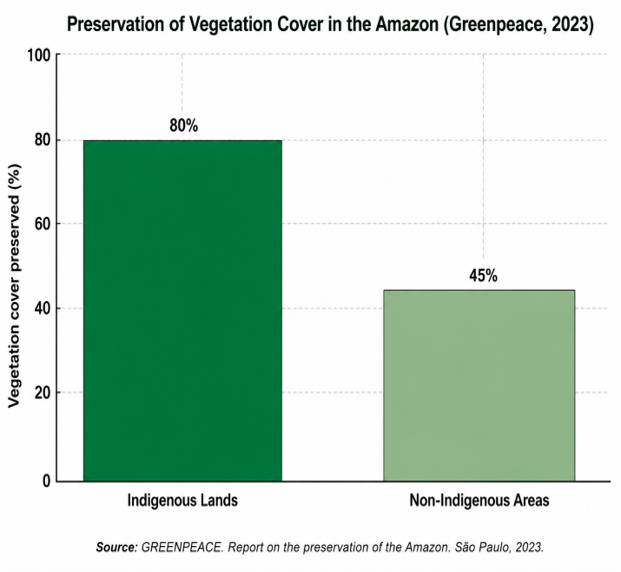
Protecting Indigenous territories can mean protecting forests. And protecting forests means protecting one of the planet’s most important carbon stores and biodiversity reservoirs.
For the Western world, land is often synonymous with private property and resources to be exploited. For Indigenous peoples, the connection is spiritual and collective. As Indigenous leader Ailton Krenak explains, nature is not an object to be exploited, but part of the community itself. There is a relationship of reciprocity, where caring for the forest means caring for oneself.
What does international law say?
The 1988 Constitution of Brazil itself guarantees Indigenous peoples their original rights to, and exclusive use of, their traditional lands. Protecting these territories is not merely a human rights issue; it is a vital scientific and legal strategy for maintaining the climatic balance of the entire planet.
In addition to its constitutional framework, Brazil is also party to the International Labour Organization’s Indigenous and Tribal Peoples Convention, 1989 (Convention No. 169). The Convention requires governments to consult Indigenous Peoples through appropriate procedures when legislative or administrative measures may affect them directly. It also emphasises participation and the right of Indigenous Peoples to determine their own development priorities.
Moreover, the Inter-American Court of Human Rights has reinforced the importance of effective territorial protection. In Xucuru Indigenous People and its Members v. Brazil of 2018, the Court addressed prolonged delays in the recognition, demarcation and protection of Indigenous territory.
Together, these legal standards point to a simple principle: territorial rights must be effective in practice. Recognition without protection, demarcation and participation leaves communities vulnerable and weakens environmental governance at the same time.
Contemporary constitutional conflict
Despite the protections afforded by the Brazilian Constitution and international law, Indigenous land rights remain the subject of significant political and constitutional dispute. The central issue is the so-called marco temporal (temporal framework); a legal theory according to which Indigenous Peoples would be entitled only to lands they occupied on 5 October 1988, the date the Constitution was promulgated.
The theory has been particularly controversial because many Indigenous communities were forcibly displaced from their territories before 1988. Requiring proof of occupation on that specific date could therefore transform historical dispossession into a reason for denying constitutionally protected territorial rights. In September 2023, the Brazilian Supreme Court rejected the marco temporal in RE 1.017.365 (Theme 1.031), holding that Indigenous territorial rights do not depend on occupation of the land on 5 October 1988.
The dispute, however, continued in the legislative sphere. In 2023, during President Luiz Inácio Lula da Silva’s administration, Congress approved Law No. 14,701/2023, which included provisions incorporating the temporal framework into the rules governing Indigenous land demarcation. President Lula vetoed these provisions, arguing that they conflicted with the constitutional protection of Indigenous rights. Congress subsequently overturned the presidential veto and restored the temporal-framework provisions to the law.
The issue was then brought before the Supreme Federal Court once again, which reaffirmed its rejection of the marco temporal on the grounds that it is incompatible with the Constitution. Nevertheless, a proposed constitutional amendment remains under consideration in the Brazilian National Congress, seeking to incorporate the marco temporal into the Constitution itself. This ongoing dispute illustrates the tension between constitutional protection of Indigenous territorial rights and attempts to establish the temporal framework as a constitutional rule.
What can sustainability law learn from the Amazon?
The Brazilian experience offers a lesson that reaches beyond Indigenous law.
Sustainability is often discussed through carbon markets, renewable energy, corporate responsibility and environmental regulation. All of these matter. But sustainability also depends on who has rights over land, who participates in decisions about natural resources, and whose knowledge is recognised by law.
Indigenous Peoples should therefore not be viewed merely as beneficiaries of environmental protection. They are rights-holders and active participants in environmental governance. Their territories can function as important barriers against deforestation, while their political participation can strengthen the legitimacy and effectiveness of sustainability policies.
Protecting Indigenous territorial rights is not only a matter of historical justice. It is also part of the legal infrastructure needed to confront biodiversity loss and the climate crisis.
*******************
This blog post is based on the paper to be presented at the conference Sustainability Law: Law’s Response to the Convergence of Crises, 16-18 September 2026, at the University of Oslo