
In Ecuador, Panchamama, or Mother Earth, has the right to exist, persist and regenerate. With this constitutional recognition in 2008, Ecuador became the first country to formally grant legal rights to nature, marking a major shift in how we think about nature and the law.
Traditionally, environmental law treats nature as an object: something to be managed, regulated and used. But these frameworks increasingly struggle to reconcile competing economic, societal, and ecological interests. The result is a fragmented system, characterised by regulatory gaps and persistent environmental degradation.
Against this backdrop, Rights of Nature have emerged as a bold attempt to reframe human-nature relations. Instead of treating nature as a property, they recognise them as legal subjects with inherent rights and legal standing. Today, over 699 rights-of-nature initiatives have granted legal rights to rivers, mountains and even whales in some 66 countries. This growing movement reflects a wider sense that our current ways of governing the environment are not working and that more fundamental, transformative change is needed.
Transformative change or battle cry for activists?
The emergence of Rights of Nature is not uncontroversial. Scholars such as Ruales et al. see in them the opportunity to challenge traditional approaches to environmental policymaking and drive real change in how we deal with global environmental issues. By centering on ecosystems, rights of nature offer a new way of thinking about people’s relationship with nature, moving away from an anthropocentric approach towards a biocentric one which recognises the intrinsic value of the natural environment. Hence, it may not come as a surprise that many early rights of nature initiatives came from Indigenous communities in places like New Zealand, Colombia, and Canada. These communities often see themselves as part of the natural world rather than separate from it.
Others such as Sachs are quite skeptical, raising concerns about practical challenges of enforcement, particularly where legal systems lack the institutional capacity to give effect to nature’s rights. They also highlight the risk of legal uncertainty, as rights attributed to ecosystems may conflict with existing property regimes or economic interests and even raise deeper objections concerning the compatibility of Rights of Nature with Western legal traditions.
Challenges have also been identified in how these laws are being conceptualised. In practice, the specific rights given to ecosystems, such as the right to exist, evolve or to restore , are sometimes vague, inconsistent, or conflicting with each other, which can make them harder to operationalise. Furthermore, legal definitions do not always appropriately reflect real-world ecosystem functions.
A regulatory ecology approach
While much of the debate focuses on whether Rights of Nature are normatively desirable or legally sound, less attention has been paid to the context in which these rights operate. In reality, to assess the disruptive potential of Rights of Nature, one must also understand the contextual framework in which they operate. Too many ambitious environmental laws have been defeated by the realities of existing market forces, lack of societal acceptance or inadequate infrastructures. From the Paris Agreement to packaging waste and water laws, several existing environmental legislation demonstrate the gap between regulatory ambition and practical implementation.
This is where the regulatory ecology approach comes into play. Regulatory ecology conceptualises environmental governance not as the product of law alone, but as the outcome of interactions among multiple regulatory modalities . These include legal frameworks, market dynamics, social norms, technological systems, and ecological constraints. From this perspective, Rights of Nature are not merely legal ideas, but part of a larger regulatory system. How well they work, thus depends on how they fit within that system.
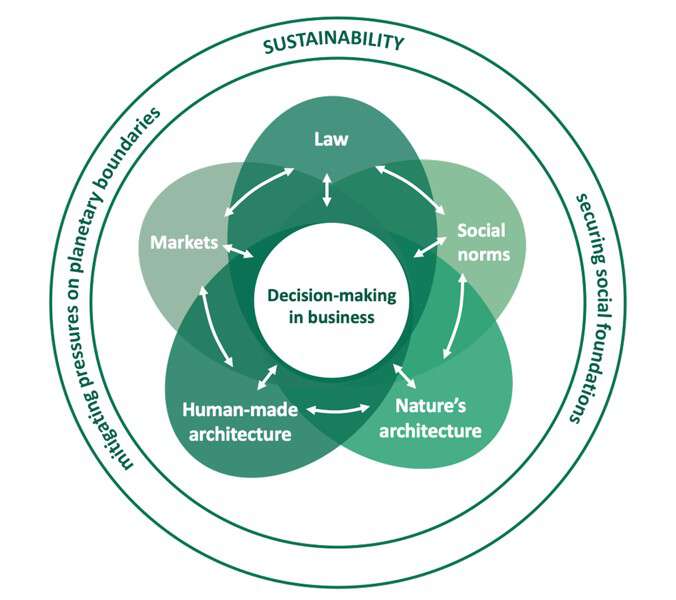
This approach offers several advantages. First, it avoids looking at law in isolation and enables a holistic analysis. Rather than treating Rights of Nature as isolated legal instruments, regulatory ecology situates them within their wider regulatory system.
Second, it provides a structured way of evaluating transformative potential. Whether Rights of Nature can meaningfully reshape environmental governance depends on context: the strength of institutions, the configuration of economic incentives, the presence of supportive social norms, and the compatibility of legal and ecological frameworks. Regulatory ecology can support identifying these enabling or constraining conditions.
Third, the approach draws attention to power relations and knowledge systems. Environmental governance is shaped not only by formal rules but also by underlying assumptions about whose knowledge counts and whose interests are prioritised. By highlighting these dynamics, regulatory ecology can enable recognising diverse value systems and knowledge traditions, including Indigenous perspectives. In this way, regulatory ecology does not simply ask whether Rights of Nature ‘work’, but under what conditions they can contribute to transformative change.
Towards meaningful sustainability lawmaking
Looking at Rights of Nature through a regulatory ecology lens has important implications for the development of sustainability law. It shows that transformative legal innovation cannot be evaluated in isolation. The success of instruments such as Rights of Nature depends on their fit with broader governance systems, including institutional capacities, socio-economic structures, and ecological realities. Legal design alone is insufficient.
Moreover, it underscores the need for context-sensitive policymaking. What works in one place may not work in another. Thus, policymakers must consider when and where specific policies are likely to be effective, and how they can be adapted to different legal and cultural contexts.
This approach also brings attention to environmental justice and power asymmetries. Transformative change is not only about protecting ecosystems but also about ensuring that the costs and benefits of environmental policy are shared equitably and that diverse perspectives are considered.
Ultimately, a regulatory ecology perspective reframes the debate on Rights of Nature. It moves beyond the polarised question of whether Rights of Nature are inherently transformative or merely symbolic. Instead, it invites a more nuanced inquiry into how legal innovation interacts with the complex realities of environmental governance.
As environmental pressures intensify, the challenge is not only to design better laws, but to ensure that they are embedded in systems capable of supporting transformative change. Rights of Nature may well play an important role in this transition, but only if we understand the ecological, social, and institutional worlds in which they must operate.
***********************
This blog post is based on the paper to be presented at the conference Sustainability Law: Law’s Response to the Convergence of Crises, 16-18 September 2026, at the University of Oslo