Investigative Interviewing for Fair and Efficient Administration of Justice
Supporting cooperation with and training for police, the judiciary, and academia to increase protection against wrongful convictions, abuse of power and torture.
About
The aim of an Investigative Interview is to obtain accurate, reliable, and actionable information during criminal investigations. An investigative interview must respect the inherent dignity and physical and mental integrity of all persons involved in an investigation - victims, witnesses, and suspects alike.
Traditional police interrogation methods often involve manipulation, undue pressure, and even physical violence, leading to human rights violations, misleading information and a heightened risk of errors of justice. Applying these interrogation techniques can result in false confessions, wrongful convictions, and ultimately a loss of public trust in the justice system.
An Effective and Human Rights Centered Approach
The methodology of Investigative interviewing offers a credible alternative to coercive interrogation techniques. It aims to obtain accurate, reliable, and actionable information without resorting to manipulation, lies, pressure, or excessive use of force. The method was developed in the UK, referred to as the PEACE model. In Norway it is referred to as the KREATIV model and training program. The adoption of Investigative Interviewing can prevent torture in custody, avert wrongful convictions, increase trust and promote the rule of law.
Bilateral and Global Outreach
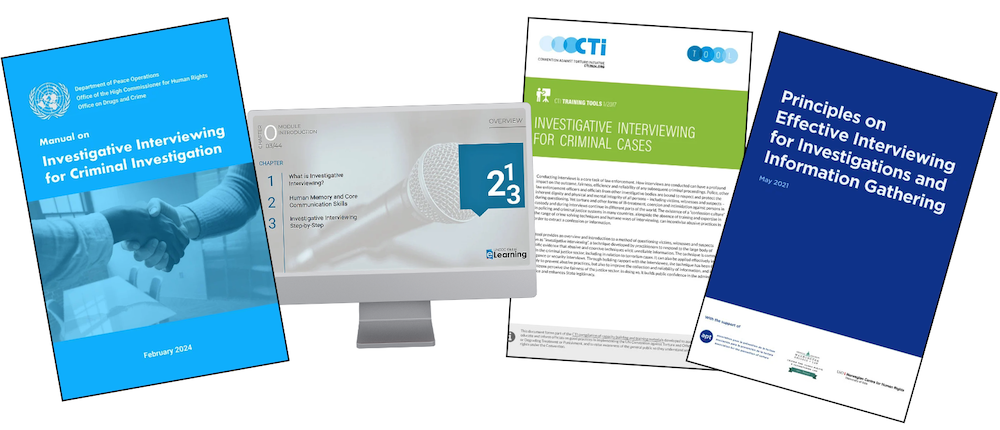
NCHR is cooperating with UN agencies, experts, NGOs, academia, and police forces in a number of countries. Together with a global network of organisations and experts, we develop tools and resources, support research, and conduct trainings to advance interviewing and investigation practices globally. Some of the material NCHR has contributed to include the UN Manual on Investigative Interviewing for Criminal Investigation, the UNODC eLearning on Investigative interviewing, the CTI training tool on Investigative Interviewing for criminal cases, and the Méndez Principles on Effective Interviewing for Investigations and Information Gathering. The "Méndez Principles" are named after the former UN Special Rapporteur on Torture, professor Juan E. Méndez, who initiated the drafting of these global guidelines.
In my time as UN Special Rapporteur on Torture, I observed that the most frequent setting where torture and coercion take place is the course of the interrogation of suspects and for the purpose of obtaining confessions. - Professor Juan E. Méndez
In September 2024, NCHR became the world's first "Méndez Centre for Investigative Interviewing".
UN cooperation
NCHR cooperates with, among others, UNODC, DPO/UNPOL, and OHCHR to enhance investigative interviewing for more effective and ethical criminal investigations. These partnerships aim to improve interviewing practices for victims, witnesses and suspects of crime to ensure more efficient and thorough investigations worldwide.
New developments
The Norwegian Méndez Centre for Investigative Interviewing, launched on 16 September 2024, is hosted by the NCHR International department's Rule of Law project. As a key player in global human rights, the NCHR leverages research, education, and dissemination to advance ethical and human rights compliant practices. The Centre integrates evidence-based methods into law enforcement and judicial training, emphasising compliance with the Méndez Principles on Effective Interviewing for Investigations and Information Gathering. The Norwegian Mendez Centre is affiliated with the project EU funded COST Action “Establishing Networks to Implement the Principles on Effective Interviewing for Investigations” (IMPLEMENDEZ, CA22128).