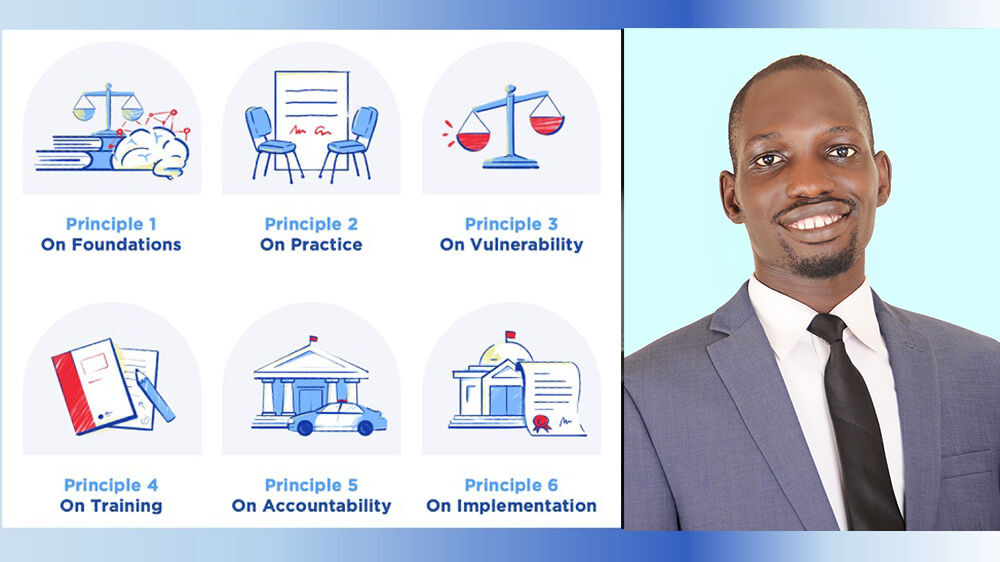
Mr. Jordan Megolonyo, a Legal Officer at the African Centre for Treatment and Rehabilitation of Torture Victims (ACTV), has authored an insightful article addressing the application of the Méndez Principles in Uganda.
He recently participated in the NCHR's Intensive Course, where he was able to share experiences, successes and challenges in the implementation of human rights law in Uganda, and compare and contrast with colleagues from all over the world. We are happy to see the discussions continue in his work, and to share his article on our website. You can read the full article here.
Understanding the Mendez Principles in a Ugandan context
The Méndez Principles on Effective Interviewing for Investigations and Information-Gathering aim to replace coercive interrogation methods with humane, evidence-based interviewing practices. Publicly launched in 2021, they propose a concrete alternative to interrogation methods that rely on coercion to extract confessions.
In a recent article, Mr. Jordan Megolonyo, a Legal Officer at the African Centre for Treatment and Rehabilitation of Torture Victims (ACTV), discusses the application of the Méndez Principles in Uganda. Currently, Uganda has a legal framework that - on paper - aligns with many of the Méndez Principles' aims. Nevertheless, Mr. Megolonyo argues that there is a significant gap between legal standards and everyday practice that "must be bridged by policy, training, monitoring and resourcing."
Even in a constrained environment, modest, well-targeted reforms can yield rapid returns. - Jordan Megolonyo
The model championed by the Méndez Principles, he argues, can help strengthen the rights of individuals, as well as increasing the effectiveness and credibility of the Ugandan criminal justice system.
Addressing systemic challenges
"Through my work as a Legal Officer with the African Centre for Treatment and Rehabilitation of Torture Victims (ACTV), I engage with the Uganda Police Force, which is a key partner in terms of investigating and documenting incidents of torture," Mr. Megolonyo explains, when asked about his interest in the topic.
"Through these engagements, certain areas which the Méndez Principles perfectly addresses have always come up - such as how to conduct safe and effective investigations. This article is the opinion of someone who has seen the hard work of Ugandan Police officers go to waste due to the use of investigative methods that result in torture, not because they intend to use poor investigative methods, but because they do not know better."
The article highlights several systemic issues he believes should be addressed, including weak oversight mechanisms, resistance to change, and the need for ongoing training that is not yet standard within police curricula.
Pathway to Reform
Despite the challenges, Mr. Megolonyo remains optimistic about the future of investigative practices in Uganda. He emphasizes that with the commitment of key stakeholders, including the Uganda Police Force, there is a genuine possibility for progress.
Through the implementation of the Mendez Principles, he argues, Uganda can achieve various positive outcomes - including but not limited to reduced use of torture, a reduction of wrongful convictions, and the collection of stronger and more efficient evidence. This could then lead to strengthened public confidence, which contribute to overall improvement of police outcomes: when trust in law enforcement grows, the community may be more likely to cooperate.
Mr. Megolonyo envisions that this is possible to achieve in the coming years.
"Regardless of the various barriers and hurdles, I believe this will be possible due to a few factors," he says.
Key to these is the forward-thinking and collaborative mindset that key officials in the Uganda Police Force have. This mindset has seen the Uganda Police make strides towards a human rights based police training and working, which is a strong foundation for the implementation of the Méndez Principles. - Jordan Megolonyo
He urges that immediate steps be taken, such as introducing structured interview protocols and binding measures against coercive interrogation, which could lead to rapid improvements despite budgetary constraints.
A Vision for the Future
Mr. Megolonyo expresses a desire to shed light on the transformative potential of applying the Méndez Principles in Uganda. "Police investigations matter," he states, underscoring that effective procedures can pave the way for justice and a thriving legal system that respects human dignity.
With commitment from law enforcement, civil society, and international partners, Mr. Megolonyo believes his vision for a more just and humane criminal justice system can become a reality.
For more insights on the Mendez Principles and NCHR's work on investigative interviewing, please visit our website.