Representatives from the NCHR visited Lviv and King Danylo University in Ivano-Frankivsk to support ongoing justice reform efforts and strengthen partnerships with the university sector.
News
Eko Riyadi has been a long-term partner of NCHR. He recently completed his doctoral degree at the University of Indonesia. His thesis pengujian proporsionalitas (testing proportionality) examined how the Constitutional Court applies the concepts of human rights limitation and derogation, and their methodology for balancing one right against another.
Investigators, prosecutors, and academics from Ukraine met in Budapest to strengthen their competence in investigative interviewing of suspects, with a particular emphasis on Russian prisoners of war. Participants received structured feedback on their interviewing practice, guided by trainers from the Norwegian Police University College and Kripos.
For the past five years, a small team of researchers and police instructors across Brazil have been trying to get law enforcement to listen more, and the results, they said, have surprised even them.
This summer, Bodø became a testbed for the future of police interviewing: 45 participants from 14 countries gathered to share practical knowledge and experiences. The event focused on implementing human rights-based investigative interviewing methodology — a promising step forward for the field, though one that still leaves plenty of room for improvement globally.
The NCHR, together with partner organization JustGroup and the universities National University of Kyiv-Mohyla Academy and King Danylo University, has been awarded funding for the project “Building Capacity for Human Rights-Based Criminal Justice Education in Ukraine.” The project is funded by The Norwegian Directorate for Higher Education and Skills (HK-dir) through the Nansen EDU programme.
In April 2026, the NCHR carried out a five‑day working visit to Kyiv as part of its long‑standing cooperation with JustGroup on strengthening investigative interviewing and investigation standards. Supported by the Nansen Support Programme for Ukraine, the visit demonstrated tangible progress within Ukraine’s criminal justice system.
On March 5, 2026, the NCHR in collaboration with the Norwegian Delegation to the Council of Europe, organized a seminar at the Palais de l’Europe in Strasbourg focusing on the importance of implementing investigative interviewing in member states. Ukraine’s great efforts to implement investigative interviewing and strengthen its criminal justice system was particularly highlighted. The seminar was followed by a live demonstration of an AI forensic head camera (JodaPro), developed by the Norwegian police team behind the AI4Interviews innovation project.
Hedda Herresthal recently completed her Master’s Research Fellowship at the NCHR, during which she submitted a thesis analysing the extent to which evidential inferences may be drawn from a child's silence during police interviews under the Convention on the Rights of the Child, the European Convention on Human Rights, and the Norwegian Criminal Procedure Act.
As Russia’s full-scale invasion of Ukraine nears its fourth year, debates over how to secure lasting peace and justice are intensifying. At a seminar hosted by the NCHR, experts and Ukrainian representatives examined how international crimes are being investigated at domestic and international levels, and how existing and emerging mechanisms can deliver accountability for crimes committed in and against Ukraine.
Criminalisation of environmental defenders constitute a significant concern worldwide. In two recent cases tried before Indonesian courts, charges against environmental defenders were dropped based on so-called anti-SLAPP legislation. This constitute the two first cases where this legal concept has been applied by Indonesian courts. Both cases was a result of human rights litigation directly supported by NCHR.
Mr. Jordan Megolonyo, a Legal Officer at ACTV and a recent participant of the NCHR's Intensive Course in Human Rights, recently wrote an insightful article exploring the challenges and opportunities of applying the Méndez Principles in Uganda. It examines the need for non-coercive interviewing techniques to replace abusive practices, outlining concrete steps for reform that could enhance investigative integrity and align with Uganda’s legal commitments against torture.
Effective investigative interviewing demands both practice and precision. In a recent workshop, participants practiced their skills through hands-on exercises and feedback sessions—an essential final step in the methodology.
Since 2019, NCHR and YLBHI have been working together to enhance the capabilities of human rights lawyers in Indonesia. Their latest four-day training focused on empowering 30 legal aid lawyers to effectively conduct human rights litigation and advocacy.
A training focused on handling blasphemy cases under Indonesian law, was held 10-12 September. This training aimed to equip participants with the skills and knowledge to conduct future trainings.
In a recent UN report, Special Rapporteur Alice Jill Edwards presented an annual overview over trends and developments in the global struggle to end torture and other ill-treatment. The report focuses on new developments and progress between June 2024 and June 2025.
Asbjørn Rachlew—a Norwegian detective superintendent and researcher at the Norwegian Center for Human Rights—recently hosted an online workshop together with JustGroup and the NCHR for participants from the Ukrainian criminal justice sector, focusing on the causes of errors of justice and strategies for prevention.
In Vienna, leaders from Ukraine’s criminal justice system gathered with experts from Norway and Britain for a workshop on improving and developing investigative management practices.
The Thai Office of the Attorney General recently convened a meeting on investigative interviewing in Bangkok, Thailand. The meeting focused on investigative techniques, inter-agency collaboration, and how to prioritize human rights within criminal investigations. As Thailand embraces these best practices, it positions itself as a champion of ethical and effective law enforcement in the region.
In June 2025, the NCHR, in partnership with JustGroup, organized a study visit to Norway for Ukrainian prosecutors centered around best practices in the investigative interviewing of children.
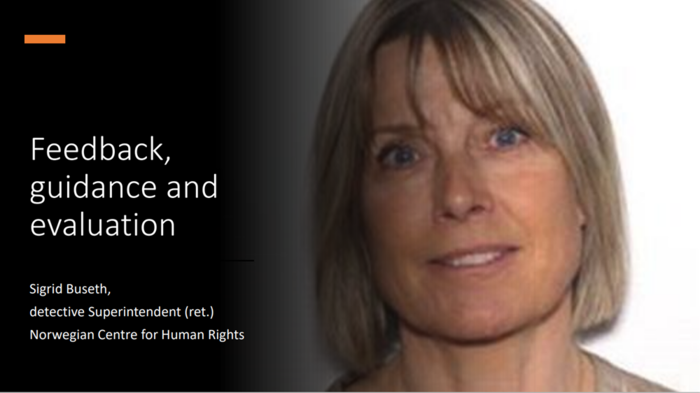
As part of the "Investigative Interviewing in Ukraine" project, Sigrid Buseth, alongside our partner JustGroup, recently led an online workshop on evaluation and feedback for over 40 Ukrainian investigators and prosecutors. This workshop marked the beginning of a new series of advanced sessions on investigative interviewing.
The Ukrainian translation of the UN Manual on Investigative Interviewing for Criminal Investigation was recently launched for use in Ukraine. On April 30, government agency representatives, experts and practitioners gathered to discuss why this tool is critical in promoting rule of law, human rights, and democratic criminal justice.
The Audit Board of the Republic of Indonesia (BPK) has developed its own Indonesian acronym for the investigative interviewing method, and the choice fell on “SANTAI” - meaning “relaxed” in Indonesian. Its implementation helps offer a respectful, empowering, and effective interview experience.
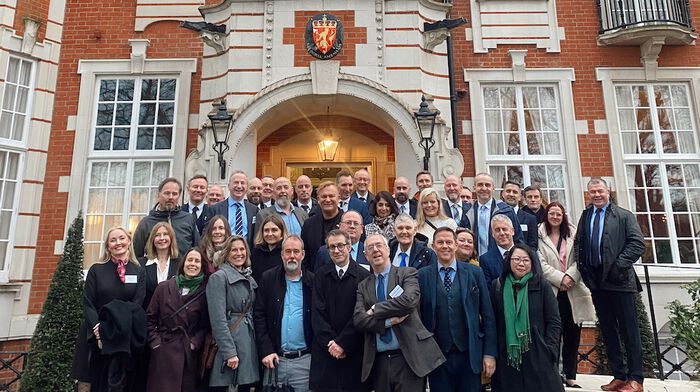
In February 2025, colleagues from Ukraine, the UK, and Norway came together to celebrate a collaborative effort in promoting human rights, the rule of law, and democracy—underscoring the importance of international cooperation during challenging times.
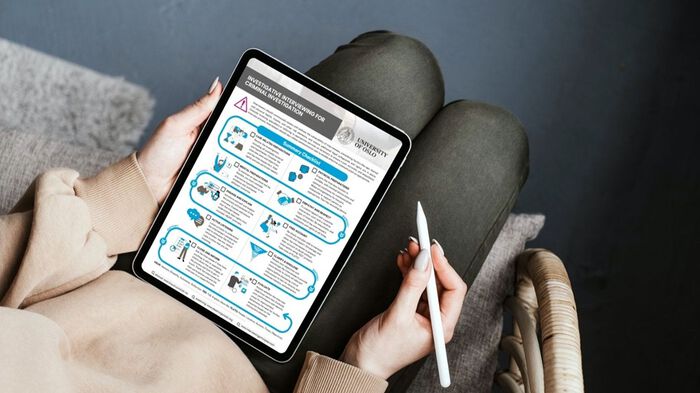
The NCHR is excited to announce the release of the “Investigative Interviewing Summary Checklist”, a groundbreaking tool designed to assist the implementation of investigative interviewing practices around the world.