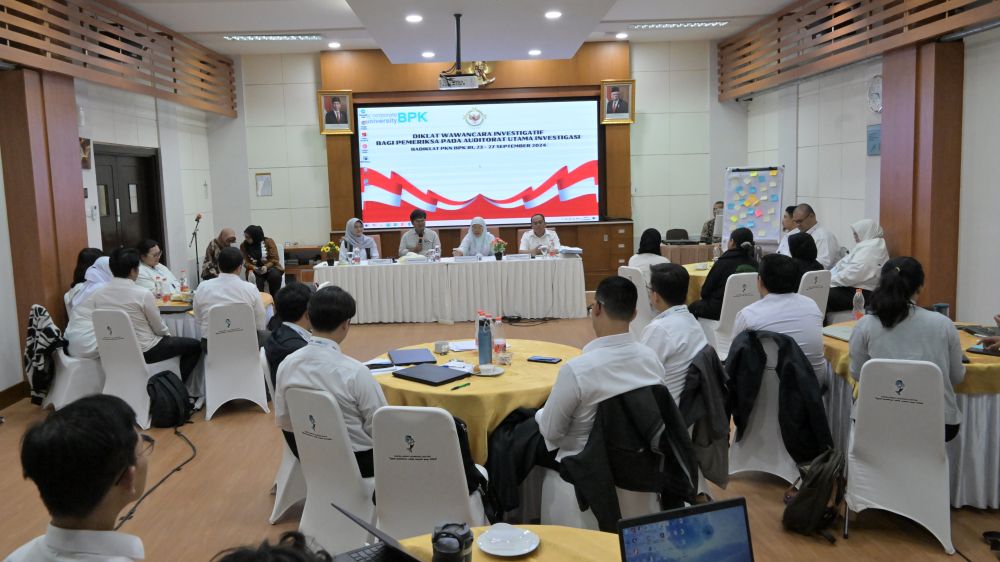
At BPK the method is primarily used by auditors tasked with examining how state finances are spent, through “investigative audits” using working methods resembling those of detectives investigating economic crimes.
A key figure supporting the introduction of investigative interviewing at BPK has been Associate Professor Dr. R. Dian Dia-an Muniroh, Director of Centre for Forensic Linguistics at Universitas Pendidikan Indonesia in Bandung. Dian is also a member of ImpleMéndez (COST Action CA22128). Since finishing her PhD in 2019 Dian has actively promoted investigative interviewing through research, conferences and workshops, as well as trainings for academics and professionals in Indonesia, Malaysia and the Philippines.
The Audit Board’s new interview guidelines
The initiative, Dian told NCHR, originated from an institutional need to revise and modernize the interview guidelines of BPK. Their director, Dr. Najmatuzzahrah, recognising the urgency and significance of this task, made it the foundation of her Transformation Project. Dr. Najmatuzzahrah envisioned a new set of guidelines that would both resonate with the cultural context and professional identity of Indonesia’s audit institution, and at the same time align with international standards.
To realize this vision, Dr. Najmatuzzahrah and her team conducted a thorough literature review, performed comparative analyses, and benchmarked global best practices—drawing on established frameworks such as PEACE (UK), KREATIV (Norway), the Mendez Principles, and the United Nations Manual on Investigative Interviewing for Criminal Investigations. Relevant elements from these models were thoughtfully adapted to suit the Indonesian context. The result of this initiative is a comprehensive set of investigative interviewing guidelines centered around the SANTAI model, developed for BPK.
A team of experts
To ensure the project’s relevance and rigor, a team of expert facilitators was brought together. In addition to Dian, the team included Eko Novan Prasetyopuspito, a senior investigator with the Indonesian National Police who has actively promoted ethical investigative interviewing practices across law enforcement agencies in Indonesia since 2015.
—This marked the beginning of my involvement in the project, says Dian. Together, we contributed our insights and expertise to the development of the guidelines.
Introducing the investigative interviewing methodology through training programs
While the guidelines were being prepared, a five-day training on investigative interviewing was held in September 2024 to introduce BPK audit investigators to humane and ethical interviewing models—such as PEACE, KREATIV, and the Mendez Principles—in order to facilitate a smooth transition to the newly developed guidelines.
At the end of the training sessions, participants were asked to write three words that captured their experience with the investigative interviewing methodology that had been introduced to them. Their responses consistently reflected a positive and encouraging tone, with phrases such as “new” “open” “convenient” “fresh” “humane” “systematic”, “practical”, and “motivating”.
Following the training, and while the guidelines were undergoing final review, BPK began applying the SANTAI investigative interviewing method in real interview settings. Feedback from interviewees included expressions such as “comfortable”, “relaxed”, “no pressure”, “different from the past”, “transparent” and “objective” all of which reflects the spirit of the method and its name, SANTAI, offering a respectful, empowering, and effective interview experience.
What next?
Following the launch of the guidelines during a webinar at the end of 2024, the next critical step is to ensure the method’s sustainable implementation in practice. Within BPK, this involves designing a structured training program inspired by the PEACE tiered approach used by UK police—ranging from foundational training for general investigators to advanced modules for supervision and monitoring—adapted to the specific context that the BPK operates within.
— Equally important is conducting research to evaluate and refine the interviewing practices, as well as publishing stories documenting their utility. These efforts will, hopefully, not only drive continuous improvement within BPK but also encourage the wider adoption of investigative interviewing and support broader transformation across other law enforcement institutions in Indonesia, Dian foresees.
— We truly appreciate the support that NCHR has provided in helping us advance investigative interviewing in Indonesia. While the results may not yet fully reflect our expectations, we are making meaningful progress.
From the NCHR's side it could be added that it is particularly encouraging to see initiatives such as this developing from within - without our prior knowledge or direct support.
SANTAI
Santai means relax, or relaxed, and in the context of interviewing it connotes “a pleasant and relaxed atmosphere”.
- The “S” stands for “siapkan”, meaning to “prepare”, emphasising the importance of being well-prepared before the interview begins.
- The second letter “A” describing the second phase of the interview is “ajak”, meaning to “invite” or “encourage” - which in this context means “to invite the interviewee to participate actively”, creating a cooperative rather than controlling environment. It is about instilling confidence, rather than persuading or coercing.
- “Narasi” is the same as to “narrate”, i.e. to “tell” which is the phase where the interviewee should provide their free account.
- Next letter out is “T” — “telaah” which could mean both to “probe” and to “examine” or “explore”.
- The second “A” is “Akhiri” which means to “end”,
- The very last phase of the interview “I” has been called “interpretasi” which in this context not only means to interpret, but also to “construe” or to “analyze”. This is the phase of the interview where you go back and evaluate it to see what information has been provided, and which new investigative steps need to be taken.