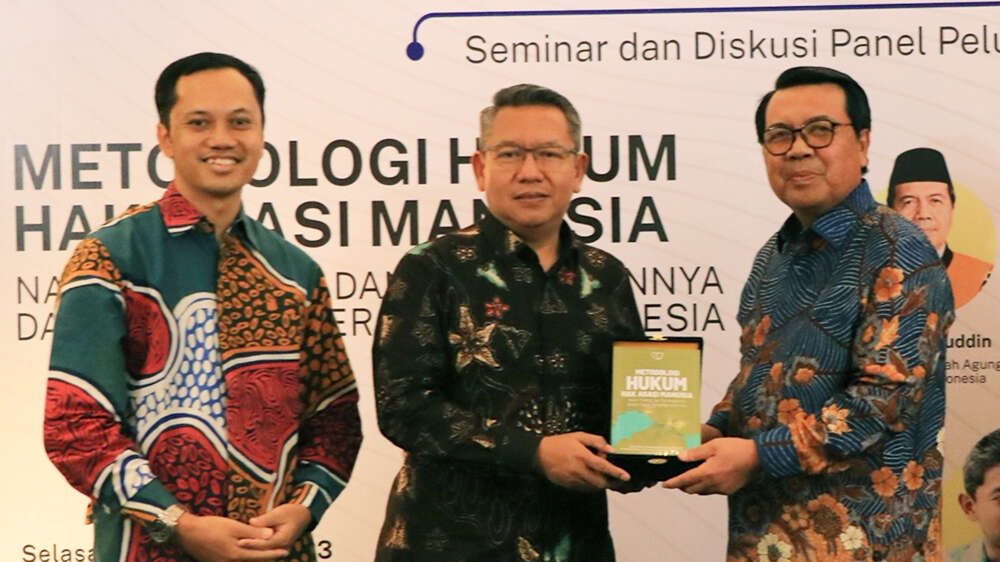
A record-high 240 persons showed up to hear his thesis defence. One of the examiners, former constitutional court judge I Dewa Gede Palguna, wrote the following blurb (freely translated):
"This book should in my opinion be obligatory reading for all constitutional court judges, practitioners and academics. A basic question in a democratic law-based country is how to explain the authority of the state to limit, or even derogate from, someone’s basic rights. The following question is then how this limitation and derogation is practiced by the courts […] this book does not only answer this question carefully, it also provides sophisticated critique of the practice of the constitutional court […]."
The thesis has been made into a book and published by Rajawali Press. It builds on, and develops further the issue of legal methodology in the Indonesian legal system, which was addressed through the books International Human Rights and Local Courts: Human Rights Interpretation in Indonesia, and Metodologi Hukum Hak Asasi Manusia, published in cooperation with NCHR.
"This book should in my opinion be obligatory reading for all constitutional court judges, practitioners and academics." - I Dewa Gede Palguna
Following his defence, Eko was invited by the Supreme Court to explain the content to 1500 Indonesian judges.
Also building on his thesis, Eko provided expert testimony before the Constitutional Court on a case concerning the Free Nutritious Meal Program, which was alleged to violate the right to education (for the sake of fulfilling the right to food). Eko’s testimony addressed the methodological approach the court should use to deal with this case.
In an important case decided in August this year, the Constitutional Court declared the criminal sanctions for insulting the state or the government under the new Penal Code, to be unconstitutional. The reasoning of the court, which addressed the proportionality between the need to protect state institutions and the constitutional right to freedom to expression, appeared to be influenced by Eko’s thesis.
Long-term partnership
For the last 12 years, Eko has been the Director of the Study Centre of Human Rights at the Islamic University of Indonesia, one of NCHR’s closest partners in Indonesia. He stepped down this summer, and Despan Heryansyah took over as the new Director.