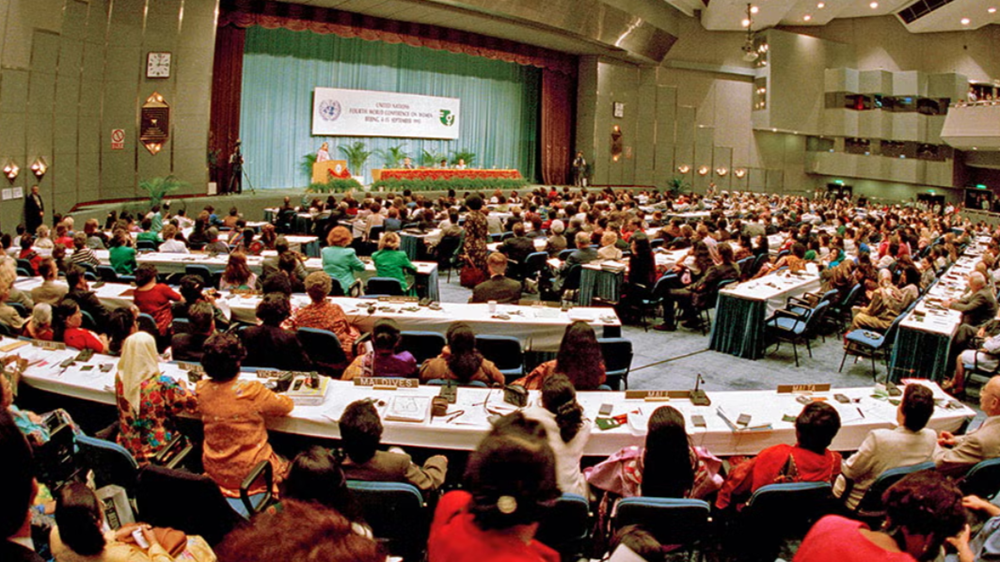
"Her Rights, Our Future, Right Now" is the theme chosen by UN Human Rights to celebrate the International Women’s Day 2025. Gender equality lies at the core of all human rights and progress on women’s rights and gender equality can transform societies, making them fairer and more resilient.
Global backlash on women's rights
The United Nations (UN) is now documenting how women’s and girls’ rights are facing unprecedented growing threats worldwide, from higher levels of discrimination to weaker legal protections. UN Women’s latest report “Women's Rights in Review 30 Years After Beijing”, published ahead of the UN 50th International Women’s Day on 8 March, shows that nearly a quarter of governments worldwide reported a backlash on women’s rights.
These developments make it more important than ever to continue advocating for the respect of human rights and to promote human rights, democracy and rule of law worldwide.
As a multidisciplinary center on research, education, dissemination and program activities on human rights, the Norwegian Centre for Human Rights International Department has integrated equality and women's rights in all its work. Here are some examples;
Successful Advocacy: Policy Advancements in FGM/C in Indonesia
In 2024, NCHR’s local partner in Indonesia Puan Amal Hayati achieved a significant milestone by contributing to the enactment of a groundbreaking prohibition on Female Genital Mutilation or Cutting (FGM/C) (Government Regulation No. 28/2024). This achievement was made possible through a series of initiatives, including capacity building, documentation and knowledge-sharing, as well as media and network campaigns. The prohibition marks a crucial step forward, but it is now essential to follow up with local campaigns aiming at changing cultural attitudes to FGM/C.
Gender equality and women’s rights in China
The NCHR works with Chinese academic partners such as the Constitutionalism Research Institute at the Institute for Human rights, China University of Political Science and Law (CUPL) to promote gender equality in China. Raising awareness about domestic violence in China, contributing to better education on gender and human rights in Chinese universities and publication of the first Chinese textbook on gender and human rights are some of the impressive achievements of our Chinese partners.
The NCHR training on gender and human rights that I attended gave me motivation and inspiration to set up my own university course for students. It also gave me a new framework and the necessary network for support. - Chinese professor or Law, Southwestern China (2024)
Police training and better evidence in gender-based violence
The NCHR is developing training and education modules on how to investigate relationship crime better. Relationship crime encompasses domestic violence, sexual crimes and abuse. The emphasis of the new modules is on how to collect more and better evidence. The materials will add to the existing modules on police and prosecutors interviewing and investigative methods anchored in the Méndez Principles on Effective Interviewing for Investigations and Information Gathering, the UN Manual on Investigative Interviewing, and UNODC e-learning on investigative interviewing that NCHR has contributed substantively to. NCHR expects the new modules to be ready in 2026. As always, we will work closely with our UN colleagues, UK based experts and academics, and the Convention against Torture Initiative (CTI).
Increased focus on women's rights in Lebanon's family courts
Since 2022, NCHR has collaborated with Lebanon's six largest family courts, aiming to integrate clearer human rights standards into their work. In today's personal status legislation, women's rights are under pressure and there is a need for more knowledge and improved tools for judges, lawyers, and other actors in the courts to fulfill Lebanon's human rights obligations. Together with our local partner, Lebanese Foundation for Permanent Civil Peace, we have conducted a range of capacity-building activities over the past three years, facilitated meetings between courts, civil society, and authorities, as well as produced studies and action plans that can form the professional basis for an increased focus on human rights in the courts.
Women's, Children's and Nature's Rights in Environmental Governance in Africa
Researchers in the field of women’s law, child law, human rights law and environmental law at the University of Oslo are partnering with researchers at universities in Kenya, Malawi and Zimbabwe to develop a Master and PhD program addressing the socio-legal consequences of the triple planetary crisis for women’s, children’s and nature’s rights in environmental governance in Southern and Eastern Africa. The programme (20121-2016) is funded by NORADs NORHED II program and explores how the CEDAW Committee’s General Recommendation No. 37 on the Gender-Related Dimensions of Disaster Risk Reduction in the Context of Climate may be used as a tool to turn the tide by centering the role of women and adopting an intersectional, equality-based approach to the effects of climate change. The programme is led by professor Anne Hellum currently at the NCHR and the Department of public and international law.
Supporting organisations and partners
The NCHR International Department has an extended network of cooperating partners in Southeast Asia and East Asia, including academic institutions, UN organs and civil society organisations. Activities at the International Department are supported by Norway.
